Construction Management is the highest circulation construction-based publication serving the UK built environment.
News
WSP feasibility study paves the way for UK rare earths supply
Cristina Lago Deputy Editor
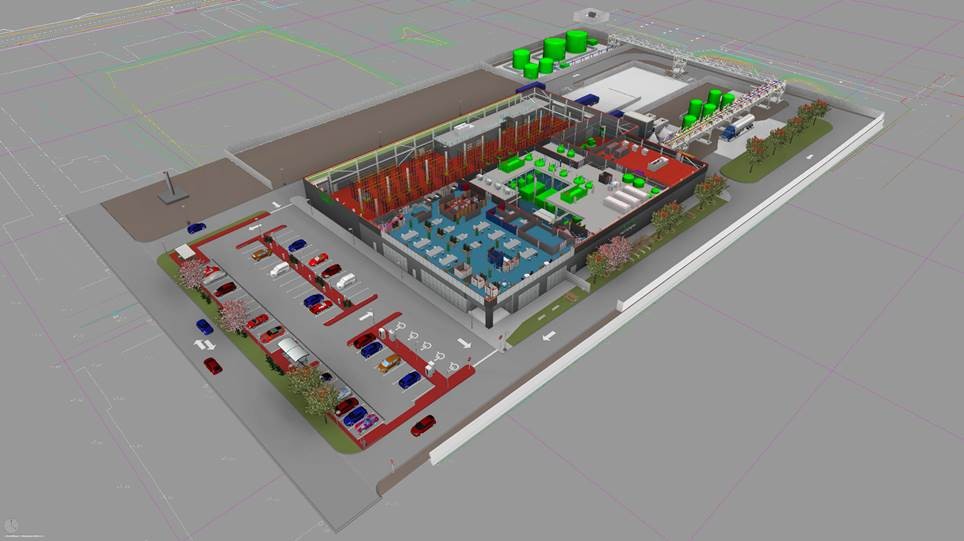
A technical render of the commercial plant WSP has designed for Ionic Technologies (Image: WSP)
WSP has completed a feasibility study for a new commercial magnet recycling plant in Belfast which could help lower dependence on rare earth elements from China.
The project for Ionic Technologies, a spin-out company from Queen’s University Belfast, involved the concept design of a commercial-scale magnet rare earth recycling facility on a brownfield site in Belfast Harbour.
Ionic Technologies said the feasibility study “demonstrates both strong financial returns and environmental sustainability” and positions the company “as the ‘first mover’ in the development of a sovereign UK/Europe supply chain”.
This is not a paywall. Registration allows us to enhance your experience across Construction Management and ensure we deliver you quality editorial content.
Registering also means you can manage your own CPDs, comments, newsletter sign-ups and privacy settings.
The feasibility study was informed by process trials taking place at a demonstration plant that Ionic Technologies is currently operating in Belfast, which it says is the “first in the Western world”.
The demonstration plant produces recycled separated magnet rare earth oxides using a proprietary technology developed by Ionic Technologies at Queen’s University Belfast and acquired in 2022.
The new commercial facility, designed by Ionic Technologies and WSP with input from the British Geological Survey and Innovate UK, would increase capacity fortyfold compared with the demonstration plant.
Subject to regulatory approvals and project funding, construction of the commercial plant is expected to be completed in late 2026 and be operational in early 2027.
Rare earth elements
Rare earth elements are essential to decarbonise the economy because they are used in green technologies such as wind turbine generators and electric vehicles.
The International Energy Agency estimates demand for them could increase to 169,000 tonnes annually by 2040.
Although they are relatively abundant in the Earth’s crust, rare earth elements are difficult to extract and process as it is unusual to find them in a pure form.
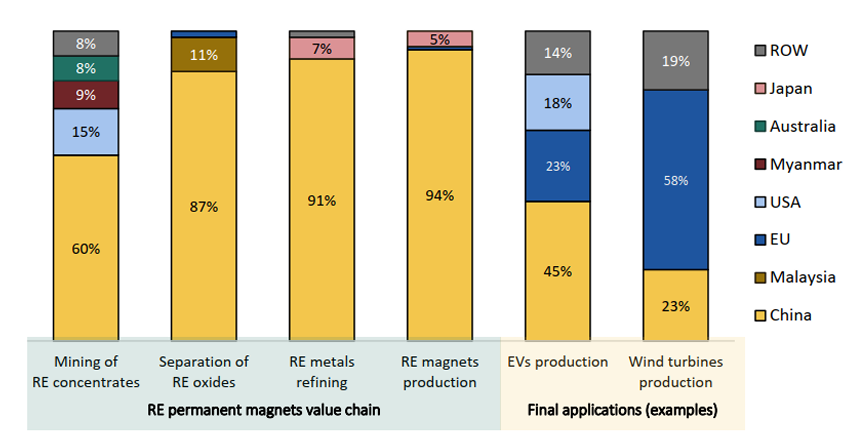
Rare earths permanent magnets value chain (Credit: Ionic Rare Earths Ltd based on data from Rare Earth Magnet Market Outlook to 2040 report by Adamas Intelligence)
To avoid reliance on Chinese exports, the EU and the US have initiated efforts to procure rare earths at home and abroad, including Brazil, Vietnam and Australia.
However, processing infrastructure can take years to set up and is unlikely to scale up in Europe or the UK at sufficient speed to reduce risks of disruptions before 2030, according to a paper by the Oxford Institute for Energy Studies.
Moving rapidly
In 2022, the government published the UK’s first ‘critical minerals strategy’ to develop a supply rare earth minerals supply chain and strengthen the industries depending on them.
Commenting on the commercial plant feasibility study, Andrew Woodward, head of industry at WSP, said: “Rare earths are critical to the future of the net-zero energy transition, and this milestone reflects our shared commitment to designing for a sustainable future and achieving net zero together.”
Brett Lynch, executive chair of Ionic Technologies’ parent company, Australian-based IonicRE, said: “This feasibility study demonstrates that IonicRE is leading the field in the race to develop a supply of rare earth oxides outside China using net-zero carbon technologies.
“Our Belfast plant is the first producer of recycled separated magnet rare earth oxides in the Western world. We are now moving rapidly to commercialise rare earth recycling, with planned commercial-scale production within just two years, offering investors direct exposure to the growth of a Western supply chain.”
The January/February 2026 issue of Construction Management magazine is now available to read in digital format.
Powered Access
CM, in partnership with IPAF, has launched a new survey to explore the industry’s views and experiences with powered access machines on construction projects.
This is not a first step towards a paywall. We need readers to register with us to help sustain creation of quality editorial content on Construction Management. Registering also means you can manage your own CPDs, comments, newsletter sign-ups and privacy settings. Thank you.