Construction Management is the highest circulation construction-based publication serving the UK built environment.
News
Wind turbine blades to reinforce concrete on HS2
CM Staff
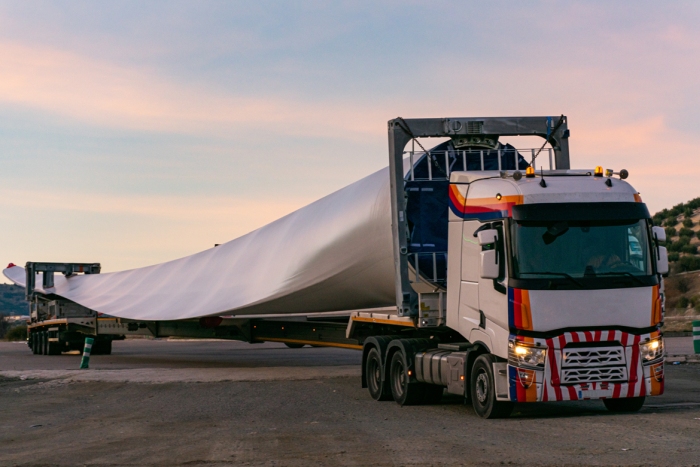
A wind turbine blade being transported by lorry (Image courtesy of HS2)
The Costain, Skanska, Strabag joint venture is to use worn-out wind turbine blades to reinforce concrete on HS2, in what is believed to be a world first.
The joint venture has been working with the National Composites Centre on the pilot, which will see sections cut from decommissioned turbine blades used to reinforce concrete instead of steel rebar.
By 2023, around 15,000 turbine blades will have been decommissioned across the UK and EU. Until now, expired blades have either been ground down to be used as building materials or sent to energy-from-waste incinerators.
This is not a paywall. Registration allows us to enhance your experience across Construction Management and ensure we deliver you quality editorial content.
Registering also means you can manage your own CPDs, comments, newsletter sign-ups and privacy settings.
HS2 claimed that substituting steel for sections of retired wind turbine blades cuts by up to 90% the carbon generated by concrete reinforcement.
Work on the pilot is due to start in spring 2021 and, if successful, could be followed by a full roll-out across Skanska Costain Strabag JV's route, consisting of HS2’s London tunnels between the M25 motorway and Euston station.
Skanska Costain Strabag JV innovation manger Harrison O’Hara said: “Wind turbine blades are extremely difficult to recycle. Ideas of what to do with them after they’re taken down range from turning them into playground slides to processing them into pellets for glues and paints.
“What’s potentially so significant about this innovation is that unlike some other turbine blade recycling initiatives, which involve reprocessing, our innovation reinforces concrete with sections simply cut from the turbines – massively reducing the carbon produced in repurposing the blades.”
HS2 innovation manager Rob Cairns said: “Reusing old turbine blades reduces waste, cuts demand for new steel and reduces the carbon generated during the production of concrete.
“This scheme is a brilliant example of the innovation happening on the whole HS2 project. If our world-first pilot project goes well, we could see a waste product from the energy industry becoming an essential material for the construction sector in the future.”
The January/February 2026 issue of Construction Management magazine is now available to read in digital format.
Powered Access
CM, in partnership with IPAF, has launched a new survey to explore the industry’s views and experiences with powered access machines on construction projects.
This is not a first step towards a paywall. We need readers to register with us to help sustain creation of quality editorial content on Construction Management. Registering also means you can manage your own CPDs, comments, newsletter sign-ups and privacy settings. Thank you.