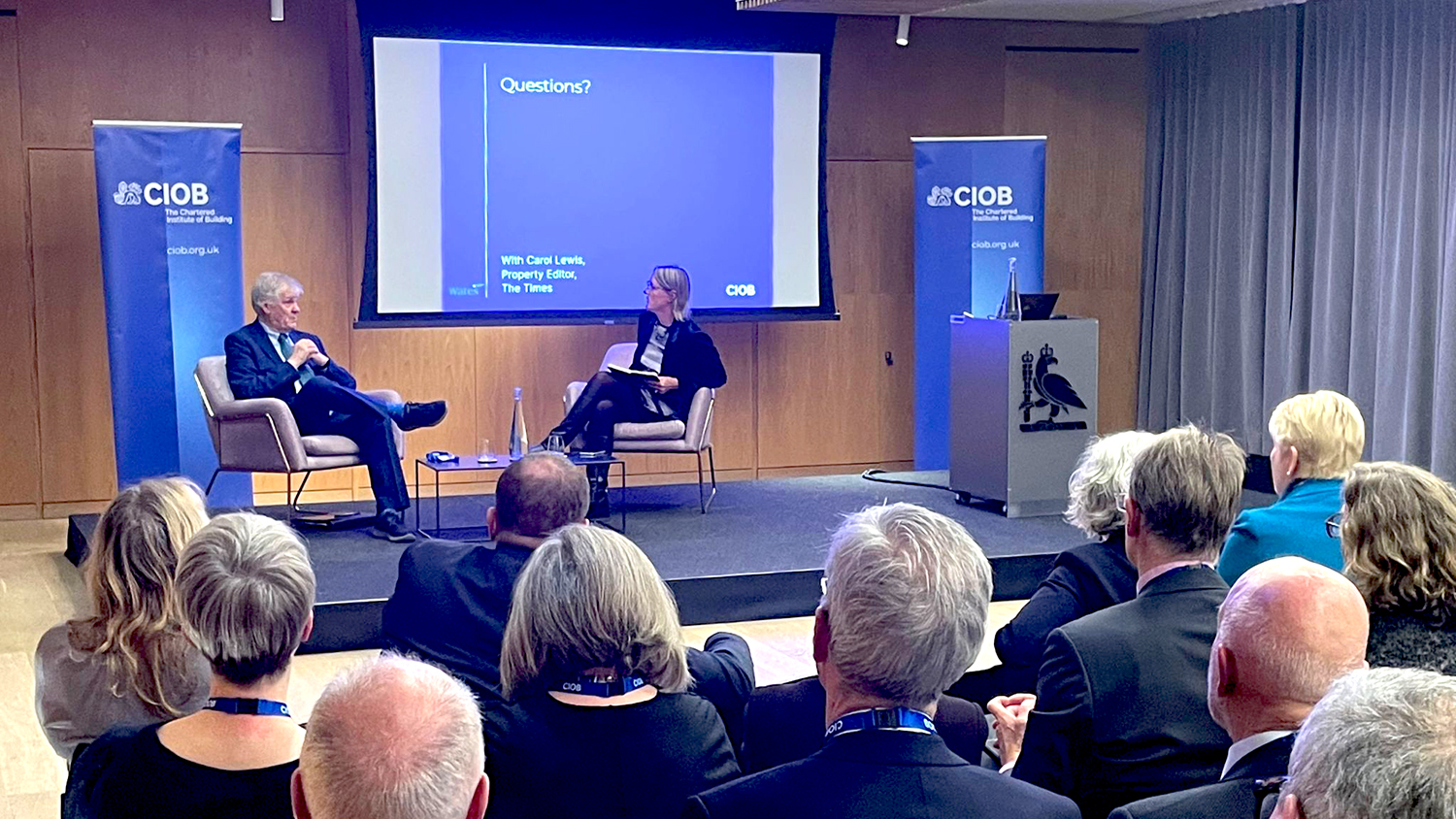
That was one of many compelling sound bites that Paul Morrell OBE delivered last week during his CIOB lecture, ‘How much longer? Why is change so difficult (and yet so necessary) in construction?’
Addressing an invited audience for an hour on 28 November, Morrell reviewed the industry’s issues with candour and humour via the prism of the government and industry’s response to the Grenfell tragedy, his ensuing review of the construction products testing regime, and his stint as government construction adviser.
This is not a paywall. Registration allows us to enhance your experience across Construction Management and ensure we deliver you quality editorial content.
Registering also means you can manage your own CPDs, comments, newsletter sign-ups and privacy settings.
Returning to standards, Morrell noted an absurdity: “We have a standard requiring the regulation of a bidet, but no standard for a fire door because Europe couldn’t agree on the standard!”
He added: “Standards are critical: standards for products, standards for testing, standards for people who do the testing, standards who do the verification of the people who do the testing, all the way up to UKAS.”
He noted that enforcement of standards and regulations is an issue: “There has been no enforcement at all. There has been not one single action under the Construction Product Regulations, not one. There has to be an enforcement system that works. People have to believe that they are not competing with people who are not bound by the same rules.”
Accident investigation
Morrell drew attention to another absurdity post-Grenfell by highlighting the role of accident investigation boards like the Air Accidents Investigation Branch or the Marine Accident Investigation Branch. He said: “We don’t learn our lessons. And there’s no machinery for learning lessons. I contrast [the construction industry’s position] with aviation. [The aviation industry] really tries to find out why a plane crashes and tries to stop it happening again.
“We have investigation boards (for aviation, rail and maritime) and I’m told they’re expensive. The Air Accidents Investigation Branch costs £4m a year; so far the Grenfell Inquiry has cost £150m and is going to top out at £200m. The police inquiry into Grenfell is £90m with 145 full-time police officers. Kensington & Chelsea has paid out £400m. The climate crisis will cost anything up to £17bn. But it’s too expensive to build a structure to monitor [construction accidents].”
What can clients do?
The event was chaired by Carol Lewis, property editor of The Times, who asked Morrell about the role of clients.
He answered: “First, they have to make up their mind about what they want and put a good team together. They must align that team.
“I’m really only interested in working in two ways: design and build, which I prefer to call ‘design, then build’; and construction management. Most of the stuff in between is fraught with danger.
“[Clients need to] be realistic about the price and the programme. [They must have] clarity and realism about what can be achieved, and the accountability that people are required to do what they say they will do.
“And the last two requirements for a client are: you should know what you can get out of the industry, otherwise they won’t give it to you. And you should also know what you can’t get.”
AI and checklists
Naturally technology featured in the lecture. Morrell dismissed visions of robots dominating the industry in the near future: “The dream of a building that will be designed by AI, delivered to site by drones and then constructed by a robot: I don’t think so. No time soon. But smaller stuff, yes. So, setting-out robots, by all means.”
He suggested a sensible role for artificial intelligence: “Nobody would take off in an aeroplane without going through checklists. Are we ready? Are we ready? If we want artificial intelligence to do anything for us, get it shout out ‘You’re not ready!’ quite early in the project.”
A BIM too far?
Among the CIOB lecture audience was Autodesk head of industry associations strategy Marek Suchocki, who asked whether the BIM movement (that Morrell helped launch when he drafted the Government Construction Strategy during his second term as government construction adviser) had aimed too high or too low?
Morrell responded: “If I think back at what hasn’t happened, I think [the BIM initiative] took off and went too high. The politicians loved the idea of Digital Built Britain, because politicians – mostly boys of course – love the idea of running the country like a train set.
“So suddenly, we were talking about Digital Built Britain, and we still didn't know what BIM Level 3 looked like.
“I think it got away from us, the middle of the industry, when it went to Cambridge University. I think it got too complicated. The standards were effective, but a lot more complicated than the ones we envisioned very early on.
“And it became too much of an intellectual plaything. But I was entirely confident, very early, that it would be unstoppable because people would see the benefits.”