












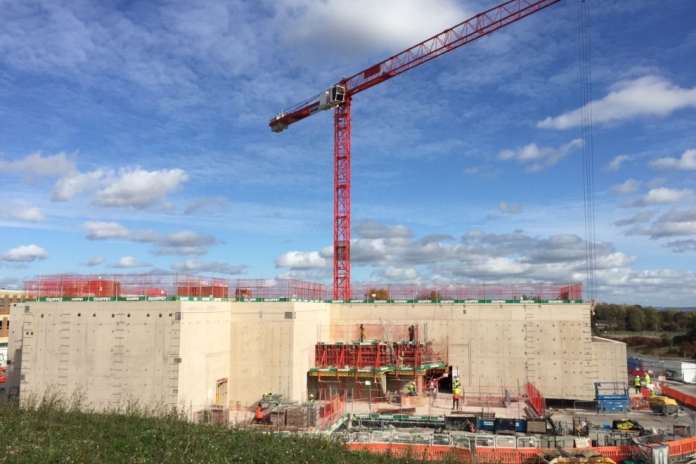
Mace has built three testing chambers for high-power lasers using large volumes of a special low-carbon concrete mix that can resist thermal cracking.
The testing chambers are housed within the Extreme Photonics Applications Centre (EPAC), a new advanced imaging centre at Harwell Campus, on behalf of the UK’s Science and Technology Facilities Council (STFC), where unique experiments will be conducted.
The walls of the chambers are 2.5m thick and 8m tall and are built to resist thermal cracking.
The team used 7,500 cu m of structural concrete with a composition of 75% Ground Granulated Blast Furnace Slag (GGBS) instead of traditional Portland Cement. A less carbon intensive alternative, this led to a 48% overall carbon reduction and a saving of 1,373 tonnes of carbon.
The composition of concrete mix was guided by specific experimental shielding properties that required the use of high density aggregates and a reduced cement content in order to minimise the risk of thermal cracks occurring as a result of the heat generated during the concrete curing process.
Due for completion in spring 2022, EPAC will house super-bright lasers that, over a few tens of seconds, can produce state-of-the-art high-contrast 3D images of the internal structure of complex objects from aircraft wings to bones.
The laser testing process will achieve temperatures of 50 million degrees Celsius, hotter than the centre of the sun. A single flash from the laser is 1 quadrillion watt which makes it 10,000 times more powerful than the whole of the UK national grid output.
Attached to the chamber a complex arrangement of labyrinths creating service and personnel access into the testing chambers. Mace said it had taken “utmost care” ensure that the internal dimensions of both chambers and the labyrinth will provide enough shielding and absorption required for future experiments.
Robert Cocks, project director EPAC, public sector construction at Mace, said: “We’re proud to work on such an ambitious and unique project, supporting our client’s ambition in driving sustainable concrete solutions. EPAC has one of the most technically challenging and complex concrete structures in Europe in 2020 and the result is testament to the strong commitment and expertise from everyone involved.’’
Professor John Collier, director of STFC’s Central Laser Facility, said: “EPAC will drive the development and application of a completely new class of compact accelerators and advanced sources of radiation based on lasers. We expect this to lead to a step change in a number of fields, for example the rapid, 3D imaging of complex or moving structures, or systems under load like engines or turbines.
“We’ve reached a very significant milestone for EPAC. I am delighted that this has been achieved on schedule whilst adhering to the necessary coronavirus controls, such as social distancing. This is a great credit to our construction partners, Mace.”
Mace is delivering three science and technology facilities at Harwell Campus -The Rosalind Franklin Institute, the National Satellite Test Facility and the Extreme Photonics Applications Centre. Appointed through the Southern Construction Framework, the projects have a total construction value of more than £133.5m.
The new facility is being built thanks to £81million of UK government and will open in 2024.


