Construction Management is the highest circulation construction-based publication serving the UK built environment.
News
Laing O’Rourke helps develop carbon-saving vaulted floors to replace slabs
Neil Gerrard Associate editor
Bath University’s Dr Paul Shepherd on the thin shell concrete floor
A new style of vaulted floor that cuts concrete usage by up to 75% could replace solid slab floors as construction moves towards net zero targets.
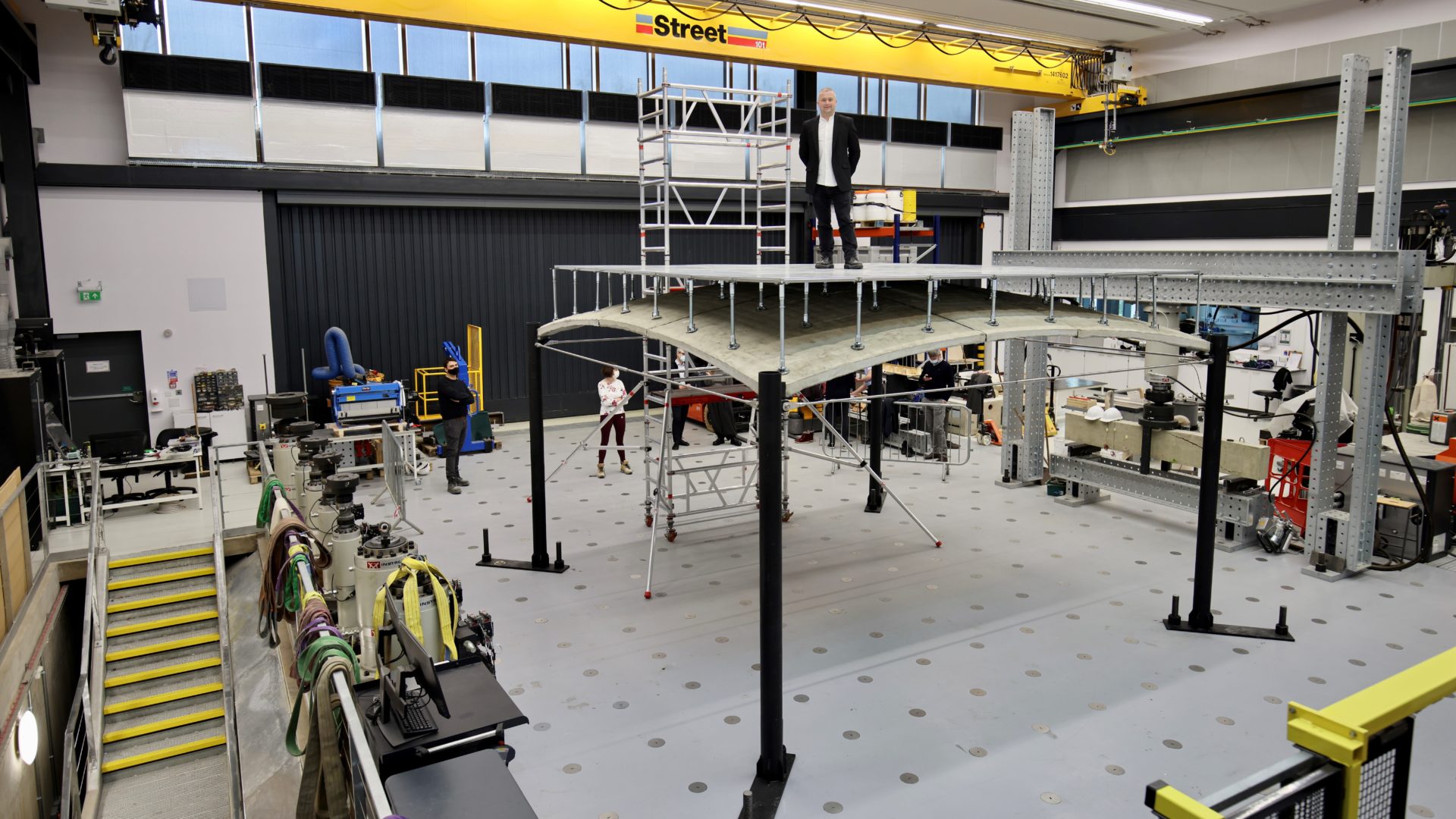
That’s according to researchers at the University of Bath, Cambridge and Dundee, who have unveiled a full-scale demonstration of a thin-shell floor. The 5m x 4.5m thin-shell structure has been built in the NRFIS laboratory of Cambridge University’s Civil Engineering Department.
The vault-shaped floor uses 60% less carbon in its construction than an equivalent flat slab that could carry the same load.
This is not a paywall. Registration allows us to enhance your experience across Construction Management and ensure we deliver you quality editorial content.
Registering also means you can manage your own CPDs, comments, newsletter sign-ups and privacy settings.
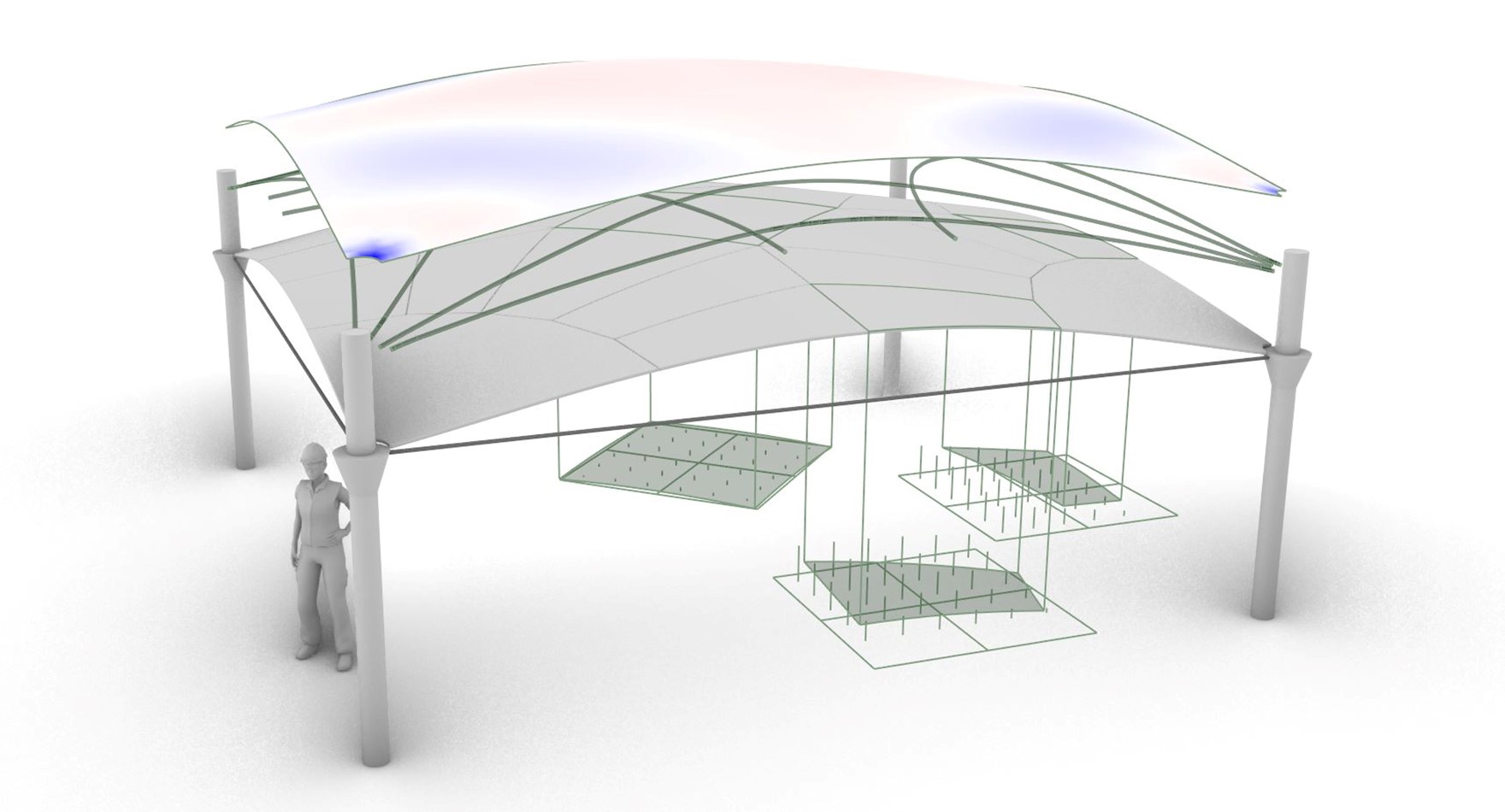
A digital image of the vaulted floor design (Image courtesy of the University of Bath)
The innovative approach plays to concrete’s strength of resisting compression. Rather than being laid flat, where it requires steel reinforcement, the concrete is used only where it is needed to work in compression. The new shape cannot be made using traditional temporary formwork, so the ACORN team has developed an adaptable mould and a robotic concrete spraying system that can be used in an offsite factory.
The team has also developed software to optimise floors for a given building design, and control the automated manufacturing system to produce them.
The test floor has been manufactured in nine transportable pieces and is joined together with a connection system. The floor also incorporates reversible joins so that it can be disassembled and reused at the end of a building’s life. Each piece took half an hour to make and the whole floor took a week to assemble. Researchers say commercial versions manufactured offsite could be produced and assembled much more quickly.
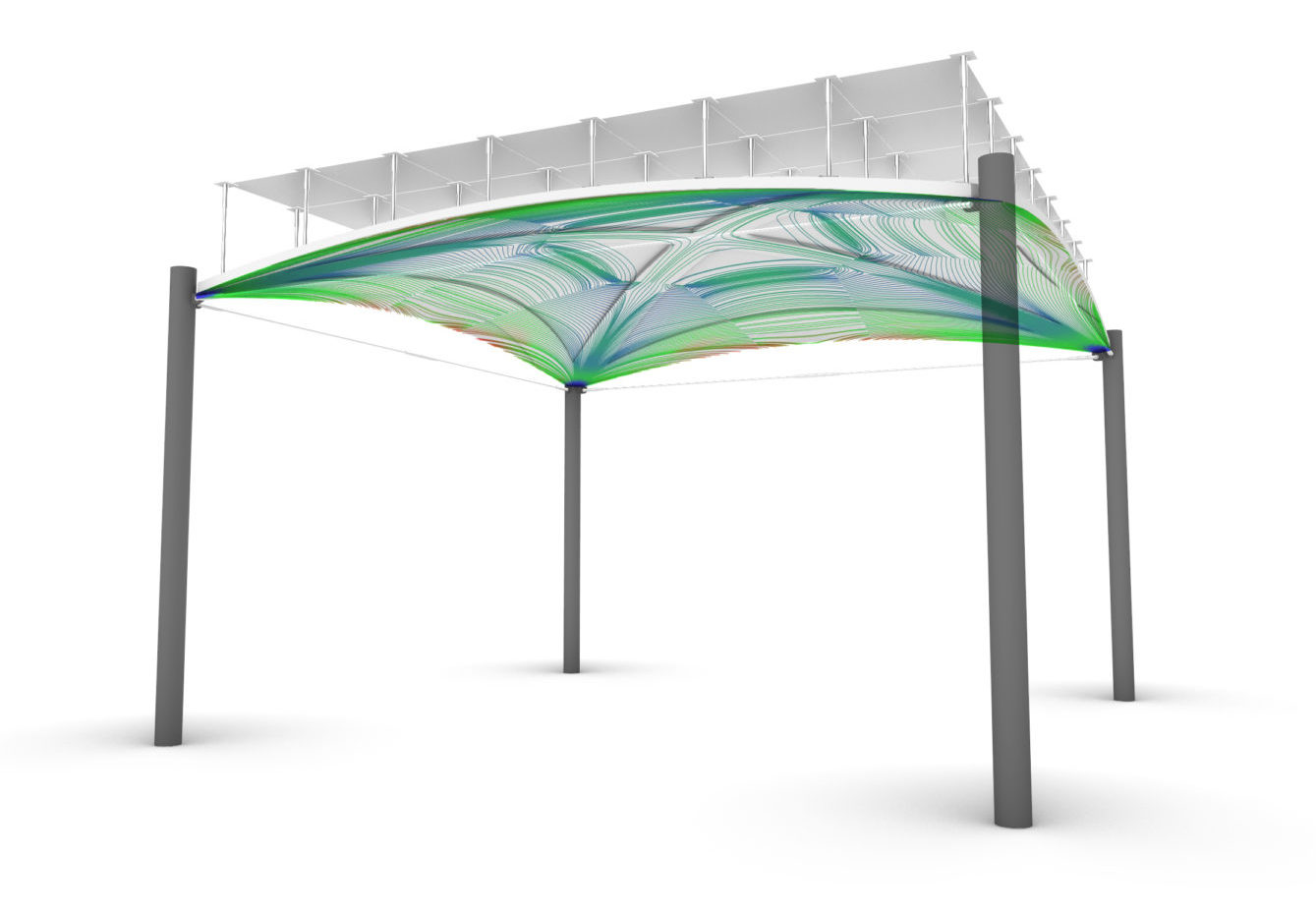
Colours represent the level of stress in the concrete (principal stress). The lines show the direction of the stress (principal stress lines). (Image courtesy of the University of Bath)
Dr Paul Shepherd, a reader in Bath University’s Department of Architecture & Civil Engineering and the principal investigator for ACORN, said: “Since concrete is the world’s most widely consumed material after water, and its production contributes more than 7% of global CO2 emissions, the easiest way for construction to begin its journey to net zero is to use less concrete. That has been the driving force behind this project, which we hope could make a major difference to the impact of construction.
“I just hope that one day soon this type of low-carbon automatically manufactured building becomes so widespread that people walk by without noticing.”
Adam Locke, programme leader of the Europe Hub Technology & Innovation at Laing O'Rourke, added: “The ACORN demonstrator is a very useful stepping stone in the progressive pathway to decarbonising our solutions and complements very well our own work in this area.”
ACORN has received funding from UK Research and Innovation under the ISCF Transforming Construction programme.
The January/February 2026 issue of Construction Management magazine is now available to read in digital format.
Powered Access
CM, in partnership with IPAF, has launched a new survey to explore the industry’s views and experiences with powered access machines on construction projects.
This is not a first step towards a paywall. We need readers to register with us to help sustain creation of quality editorial content on Construction Management. Registering also means you can manage your own CPDs, comments, newsletter sign-ups and privacy settings. Thank you.