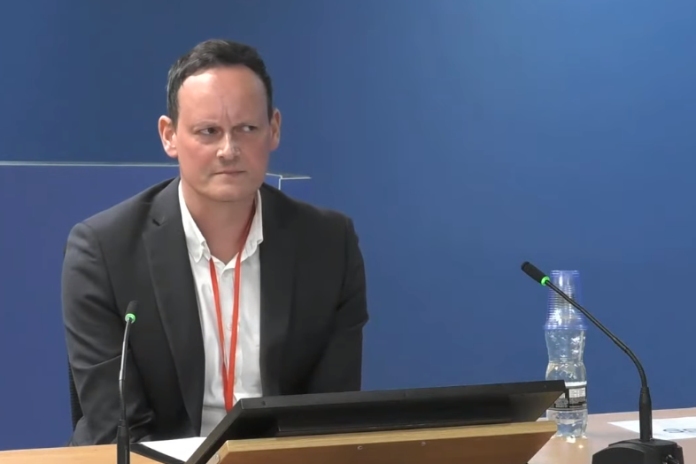
The revelation came to light while the Inquiry heard from
witness Zak Maynard, who was Rydon’s managing surveyor on the project in 2014
before later being promoted to commercial manager.
Maynard explained that Rydon regularly used firms like JS
Wright and Harley Curtain Wall (who eventually went on to become subcontractor
on Grenfell Tower).
But when it came to submitting a tender for Grenfell, a
January 2014 email from Rydon estimator Katie Bachellier, on which Maynard was
copied in, indicated that JS Wright would “struggle” to return a tender from
the project because it was “snowed under” with enquiries from Rydon
Construction.
Rydon refurbishment director Steve Blake then wrote to JS
Wright and asked them to review the situation because Grenfell was “the best
opportunity that Rydon have”.
On 8 January 2014, an internal Rydon email indicated that
the firm had requested an extension of time on its tender from Kensington and
Chelsea Tenant Management Organisation’s (KCTMO) agent Artelia. Bachellier warned
that the contractor would have a “massive problem” if it were not granted.
She added later in the email: “Perhaps we could also cite
the fact that we are struggling to drum up any interest from cladding
contractors in relation to this project?”
Maynard said he believed that other cladding firms had been
approached in relation to the project but didn’t know who they were.
‘Value engineering’ savings
Leading counsel to the Inquiry Richard Millett QC also probed
Maynard on cost savings Rydon made during the project. It emerged in March 2014
that it had made an error in its tender sum amounting to £212,000.
Refurbishment director Steve Blake said in an internal email
that the problem was “disappointing but not unexpected” and that “hopefully
there will be something to compensate”.
Bachellier replied: “I think we will recover this from
Harleys by taking the timber window reveals out of their package but that will
mean we have to work a little bit harder of finding some significant VE savings”.
Asked if he understood this to mean that Rydon was
contemplating identifying value engineering savings that would compensate for
the error, Maynard replied: “Potentially, yeah.”
Meanwhile, it emerged that KCTMO’s budget for the
refurbishment works was £8.4m, £800,000 less than the £9.2m winning bid
submitted by Rydon, which meant more savings needed to be found.
Despite the size of the sum of money that needed to be saved, an email from Steve Blake to the TMO said he saw “no reason why this [the saving] can’t be achieved”.
Millett then asked Maynard about an email from Mark Harris
at Harley Curtain Wall to Rydon detailing proposed cost savings, with large
savings by using ACM cladding panels rather than zinc cladding, and even bigger
savings using face-fixed ACM panels rather than cassette ACM panels.
It set out a series of options to save money on Harley’s January
2014 bid of £3.7m based on Proteus zinc cassette cladding with birch-faced
plywood window reveals. The schedule of savings showed that using uPVC window
reveals instead of birch-faced plywood would save around £74,000, while using
Reynobond standard silver-colour aluminium cladding cassette in lieu of Proteus
zinc cladding cassette would save £419,000 and Reynobond standard silver-colour
aluminium cladding face fix in lieu of Proteus zinc cladding cassette would save
£576,000.
However, when Katie Bachellier at Rydon sent an email to the
TMO detailing value engineering options, the main contractor quoted a saving of
£293,000 for the alternative aluminium system cassette and £376,000 for the
face-fixed option – some £200,000 less than the saving quoted by Harley.
Millett asked Maynard why he didn’t tell the TMO what the
real saving was. Maynard replied: “Because that wasn’t the saving that Rydon
wanted to give.”
No formal written agreement
Millett also questioned Maynard about the appointment of Harley
Curtain Wall, which he asserted “never entered into a comprehensive formal
written agreement” for the Grenfell Tower works.
Maynard explained how Harley had initially signed a letter
of intent to complete façade design works to the value of £30,000 in July 2014.
In August 2014, Harley director Mark Harris asked Maynard
when contract documents for its work would be ready and Maynard said they would
be sent to him “shortly”.
However, by 16 September 2014, Harris emailed again to say
that “in order to maintain programme”, Harley needed to order special dyes and
bar length material worth £325,000 and requested either an increase in the value
of the letter of intent, or the subcontract in place “as soon as possible”.
Maynard increased the letter of intent to the full value of
Harley’s lump sum price of £2.6m.
When Maynard was asked why two weeks had elapsed he had
promised that the contract documentation would be sent out “shortly”, and why
he didn’t proceed directly to a formal contract rather than increasing the
letter of intent, he answered: “Workload”.
Millett drew Maynard’s attention to the letter of intent
which requested acknowledgement from Harley and the signing and returning of a
duplicate. However, the signature block for Harley was left blank and Millett
said that no signed copy could be found. Maynard said he did not recall chasing
for a signature.
Millett asked: “Was it common for Rydon to allow nearly £3m
worth of work to be undertaken without a formal signed agreement in place?”
Maynard replied: “No. Normally there would be a full order
in place.”
Asked if it caused any concern later, Maynard answered: “At
the end, when obviously Harleys then went into administration it was a worry
that we had realised it could have become an issue.” Harley Curtain Wall
entered administration in 2015 and was sold in a pre-pack deal to Harley
Facades.
The Grenfell Tower Inquiry continues.