Construction Management is the highest circulation construction-based publication serving the UK built environment.
News
Grenfell: Rydon manager ‘assumed’ windows had fire-resistant seal
A site manager working on the internals at Grenfell Tower assumed that a paper and foil material installed by subcontractors between window units and internal sills in the building was a fire resistant barrier, the Grenfell Tower Inquiry has heard.
Gary Martin, who worked on the project between 31 July 2015
and 18 March 2016, before leaving the company in 2018, said in his written witness
statement that SD Plastering were “fitting a fire resistant seal between the
window unit and internal sill as well as installing the UPVC”.
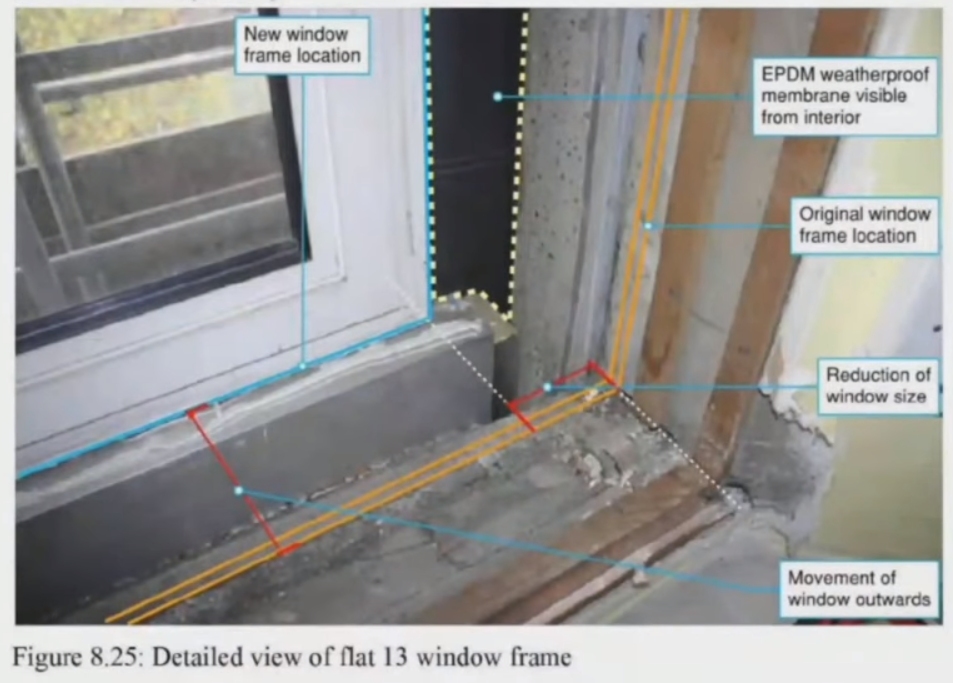
Counsel to the Inquiry Kate Grange QC asked Martin to point out the seal in a photo (pictured below) in expert Dr Barbara Lane’s report of a window in the tower with the uPVC trim removed and asked him to indicate where the fire-resistant seal would have been.
This is not a paywall. Registration allows us to enhance your experience across Construction Management and ensure we deliver you quality editorial content.
Registering also means you can manage your own CPDs, comments, newsletter sign-ups and privacy settings.
Martin said: “It would have gone from the uPVC window on
that little ledge inside right the way through to the front of the opening
actually inside the flat…So it was a complete barrier all the way round.”
He added that he assumed the paper and foil material was “some
kind of fire delay and smoke deterrent”. Asked why he believed that to be the
case, he said: “It had to be there for a reason, otherwise we wouldn’t have put
it in.”
Grange told Martin that experts found that the material with a foil face around the window was combustible insulation, sometimes branded Celotex and sometimes Kingspan. She asked: “Do you agree, looking at this now, that what you thought was a fire resistant seal or a fire barrier was actually that combustible product?”
Martin replied: “Yes.”
She added: “I think we’ve established earlier that your
evidence in your statement that it was a fire-resistant seal or a fire barrier
was merely an assumption you made….But nobody actually told you that on site.
Is that correct?”
Martin replied: “I don’t recall being told anything like
that.”
Internal window reveals inspection
Martin confirmed that he was responsible for inspecting the internal window reveals before the uPVC was installed to make sure that the barrier was in place, looking for any gaps and making sure it was fitted correctly.
Grange asked why Martin was looking for gaps. He replied: “Because
I had been told to look out for gaps. Just to make sure that the work was done
completely.”
Grange continued: “Does it follow from your answers that you
didn’t ever check for yourself whether the placing of this insulation board was
compliant with the Building Regulations or any other industry guidance?”
Martin said: “No, I didn’t, because it had already been
started and I just took over the role.”
The Inquiry continues, after a break in August, resuming on
7 September.
The January/February 2026 issue of Construction Management magazine is now available to read in digital format.
Powered Access
CM, in partnership with IPAF, has launched a new survey to explore the industry’s views and experiences with powered access machines on construction projects.
This is not a first step towards a paywall. We need readers to register with us to help sustain creation of quality editorial content on Construction Management. Registering also means you can manage your own CPDs, comments, newsletter sign-ups and privacy settings. Thank you.