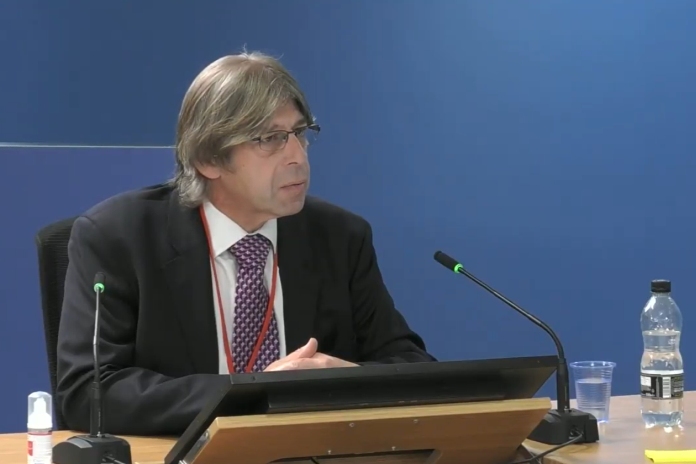
Giving evidence yesterday, cost consultant Simon Cash from
Artelia (previously known as Applyards) was asked by lead counsel to the
Inquiry Richard Millett QC about a May 2013 email from Appleyards associate
director Robert Powell to colleague Philip Booth on which Cash was copied in.
In the email, Powell remarked that Peter Maddison, director
of assets and regeneration at the TMO, had been over-ruled by Laura Johnson,
head of social housing within RBKC on the matter. The email added: “She wants
to keep the works for the boxing club and nursery and doesn’t want to progress
the kitchens and bathrooms at this stage necessarily. Also PM [Peter Maddison]
not keen on progressing with Leadbitter. Our report kicking all this off was
based on the objective of preserving programme – This now not so important. Value
for money is…”
This is not a paywall. Registration allows us to enhance your experience across Construction Management and ensure we deliver you quality editorial content.
Registering also means you can manage your own CPDs, comments, newsletter sign-ups and privacy settings.
Artelia had previously written a report in April 2013, written by Robert Powell, which was produced because progress on the project had been slow and was outside the parameters for time and cost. Listing the reasons for the slow progress, the report said: “Client brief has been allowed to develop in a piecemeal fashion over time; Absence of a controlled and managed scope for the project; Late commitment to a defined construction budget…Absence of earlier intervention; Absence of proper change control applied to the design brief; and slow reaction of the proposed contractor to address and align cost plans.”
The report noted that the project was “effectively stalled” because of a £1.2m difference in what Leadbitter said the work would cost and the cost plans of the project quantity surveyor.
But the report went on to say that plans to re-tender the
work were “not a viable option” because “the overall cost of the scheme is in
excess of the budget, which would indicate more fundamental action is required
than to just change the contractor”.
The report, which questioned the legality of “usurping” Leadbitter,
added: “Replacing the principal contractor at this stage will incur additional
time and expense without the guarantee that the TMO would be any better served
by the replacement…Leadbitter’s knowledge of the overall scheme, the client and
the project team is lost.”
As a result, Artelia recommended retaining Leadbitter. It went
on: “Appleyards opinion that unless the project, in its current guise, is
stopped and a fundamental review embarked upon to re-define the scope,
programme and cost, it will fail.”
Subsequently, a meeting in May 2013 between the TMO and Laura
Johnson saw the TMO clarify its position, with “value for money…to be regarded
as the key driver for the project”.
“Irregular and improper” re-tender process
Millett then moved onto the re-tender process for the
contract. He asked Cash about an internal Rydon email sent in March 2014,
during the OJEU process, where director Steve Blake told colleague Tim Shutler:
“At the housing conference we had meetings with senior representatives from K+C
and my opinion is that in the event that we were the [successful] contractor
they would have no issue signing up to a form of documentation as we suggest.”
It went on: “We have been informally advised that we are in
pole position – ours to lose.”
Cash said he was not aware that Rydon had been informed
informally of its performance in the tender, even before the interviews had
taken place.
He said that if he had discovered that fact, the tender
process would have been “compromised”. He agreed with Millett’s suggestion that
the informal information that Rydon was in pole position was “irregular and improper”.
Millett also raised a March 2014 discussion within Artelia
about how to “bridge the gap” between the £9.2m tender submitted by Rydon and
the client’s £8.5m budget. The TMO had advertised the contract based on a value
of £8m-10m and Cash pointed out that contracting authorities couldn’t undertake
negotiations with tenderers prior to a contract award without breaking EU
regulations.
Cash suggested “placing the contract at the submitted tender
value and an offline discussion with the preferred contractor…There is absolutely
nothing to say that once in contract the KCTMO cannot look for ways of making
savings and as part of the informal discussion, the intention can be made clear
and although not binding, the contractor’s agreement sought to work with KCTMO
to achieve the required savings.”
Millett asked: “There wasn’t any contemplation of even any
informal discussion with those other tenderers, only with Rydon?”
Cash replied: “That’s correct.”
Millett then asked Cash if he was aware that Rydon had been
asked by the TMO to find savings of £800,000 on the cladding of the building
before the contractor had been notified that it was the successful bidder. Cash
said he wasn’t aware of this and confirmed that he was “shocked” to discover
this had happened.
The Inquiry continues.