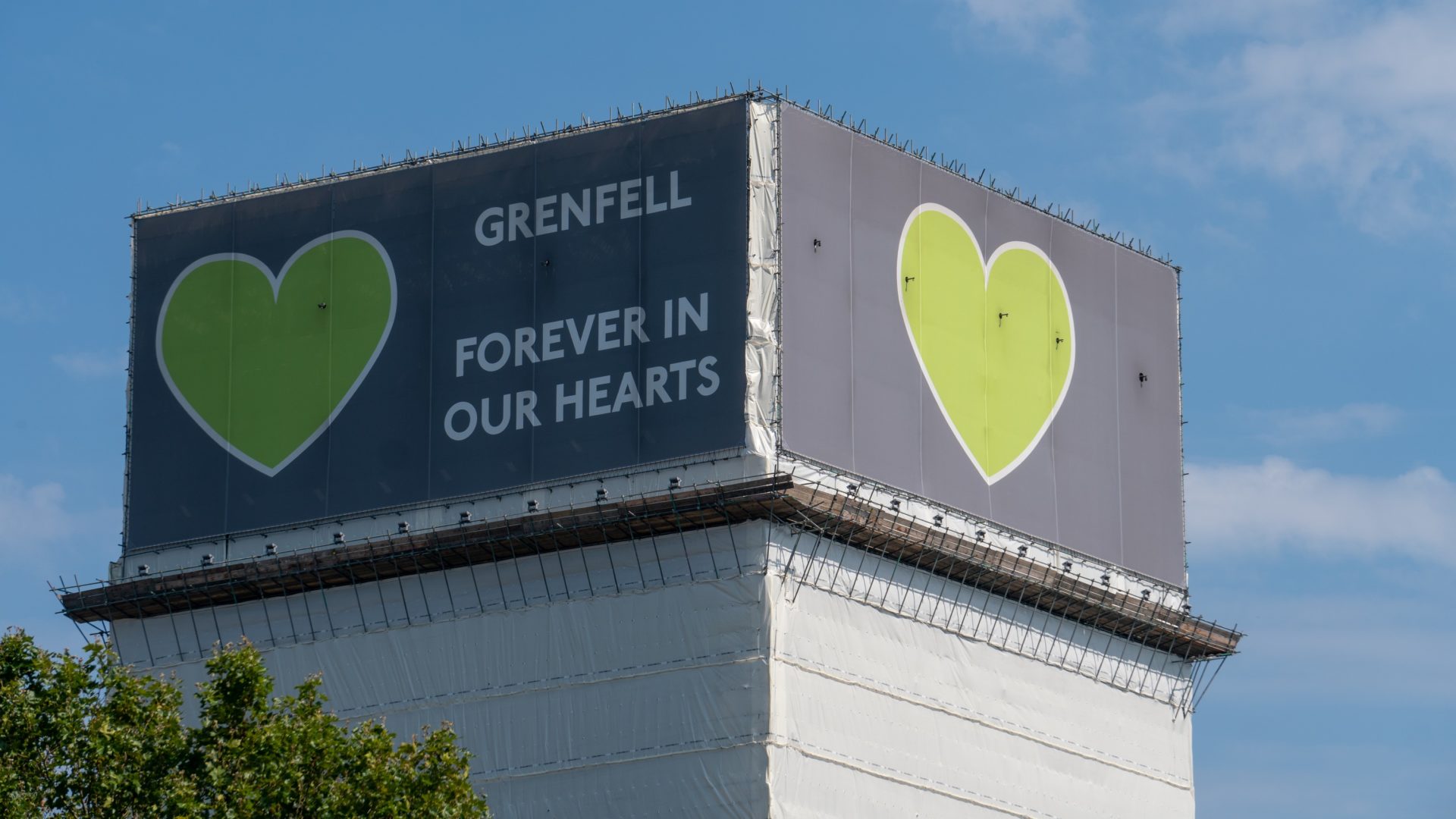
Stephanie Barwise QC, who represents some of the bereaved and survivors of the 2017 fire that killed 72 people, made the comment as she gave her closing statements for modules one and two of the Inquiry’s second phase.
A closing submission by the legal team representing the bereaved and survivors, of which Barwise is a part, said: “Lack of competence, which brings with it a lack of sense of responsibility, and wilful non-compliance are the hallmarks of the Grenfell project.”
This is not a paywall. Registration allows us to enhance your experience across Construction Management and ensure we deliver you quality editorial content.
Registering also means you can manage your own CPDs, comments, newsletter sign-ups and privacy settings.
It asserted that members of the design team for the refurbishment, main contractor Rydon, and subcontractor Harley “either simply did not consider” Building Regulations and Approved Document B, “or if they did address them, did not claim to have misunderstood them or been confused at the time”.
Its submission also accused Royal Borough of Kensington and Chelsea building control officer John Hoban, who was responsible for the cladding, as being “woefully unaware” of the requirements of Building Regulations and Approved Document B.
“It must also be remembered that those within the construction industry, indeed those involved at Grenfell Tower, knew, or should have known, that plastics were highly combustible. This should have informed their view of compliance with Building Regulations and Approved Document B2 and to the extent that there was ambiguity, it should have been resolved in favour of safety. The pretence maintained by some that they either did not know the materials were plastic, or if they did, did not appreciate their flammability, is not credible,” it added.
It went on to accuse insulation manufacturers Kingspan and Celotex and cladding manufacturer Arconic of being “well aware of the dangers posed by their products”.
It accused the firms of “frauds” practised on the market “compounded at the time by so-called independent certifiers/test houses whose complicity cannot be explained away merely by incompetence. Both the manufacturers and certifier/test houses’ contemporaneous behaviours are now compounded by the lack of candour and/or ability to reflect on their behaviour, demonstrated by almost every single witness for the manufacturers and most of those for the independent certifiers/test houses.”
Regulatory system ‘not fit for purpose’
In its closing submission, architect Studio E (now in administration) blamed the regulatory system, pointing to the interim report in the Hackitt Review, dated December 2017, that it was “not fit for purpose”. It said that confusion and loose interpretation of the system “had permitted the routine use of what are now considered to be unsafe cladding materials on buildings for many years”.
It pointed to the fact that the government has identified 469 buildings with ACM cladding systems unlikely to meet the Building Regulations. It also claimed that designers had been “misled” by materials and testing data that led them, as well as building control officers, to consider that products were safe. It added: “The certificates obtained from industry bodies such as BRE, LABC, BBA and NHBC (on which professionals in the industry reasonably relied) are now known to not accurately reflect the risks posed by some of those products, which further misled designers to consider that these products were safe.”
Studio E also submitted that expert witness Paul Hyett, who reported on the architectural design in relation to the refurbishment did not, in its view, “qualify as an expert and his evidence should be given little or no evidential weight”.
Overcladding: ‘A world of snares and pitfalls’
In its closing submission, the Royal Borough of Kensington and Chelsea admitted that its building control service had made “a number of failings” in the way it processed and considered the application for building control during the refurbishment of Grenfell Tower and “apologises unreservedly” for its failings.
It said the aim behind refurbishing the tower was to improve its thermal performance and its appearance, with a “small industry” springing up to overclad tower blocks. But it added: “The hard truth, which was starkly illustrated by the evidence heard in Modules 1 & 2, is that the overcladding market was dysfunctional and poorly regulated. A building owner entering it was entering a world full of snares and pitfalls.”
Highlighting examples of what it claimed were manufacturers like Arconic, Kingspan and Celotex not being open about the testing of their products, it added: “Some of these were present through the deliberate actions of leading industry players. Others existed because the relationship between manufacturers and those involved in testing and certifying their products lacked the open, collaborative character that could, and should, have been present.”
The council also argued that organisations including contractors Rydon and Harley had “proved equally incapable of evading the potential snares and pitfalls” despite both previously having worked on the overcladding of high-rise buildings such as the Chalcots Estate in Camden, and Ferrier Point in Newham, where Reynobond PE55 provided by CEP was used on both.
Meanwhile it noted that Studio E had no previous experience of overcladding high-rise buildings.
The Inquiry continues.