












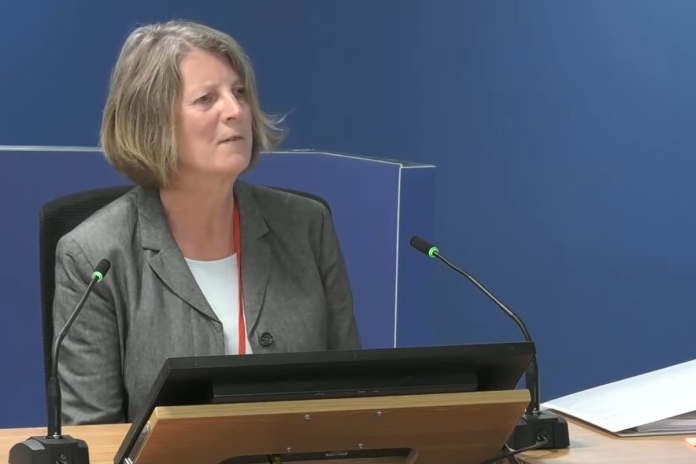
The project manager at the Royal Borough of Kensington and Chelsea Tenant Management Organisation (TMO) in charge of the Grenfell Tower refurbishment said she wished “in hindsight” that she had obtained a written assurance that the ACM cladding on the building was flame-retardant, the Grenfell Tower Inquiry has heard.
Claire Williams, who worked at the TMO from 2013 until May 2018, sent an email in November 2014 to Philip Booth at employer’s agent Artelia, in which she said that she was aware that an issue at Lakanal House meant that “the replacement panelling for the asbestos cladding was not flame retardant”. Six people died in a fire at Lakanal House in Camberwell, south London, in July 2009.
Booth replied that having reviewed the NBS specification for Grenfell’s cladding, he “would anticipate” that it required flame retardance and suggested she clarify this with Rydon.
Williams then wrote to Rydon’s contracts manager Simon Lawrence and asked for “clarification” on the fire retardance of the cladding, saying she had had a “Lacknall (sic) moment”.
But lead counsel to the Inquiry Richard Millett QC said there was no record of a reply from Lawrence. Williams said she believed Lawrence had given her a verbal assurance later the following week at a site meeting, saying: “Of course it meets those standards.”
She added that “in hindsight” she wished she had pressed Rydon for a clear written answer to the question. “I’d clearly copied in my employer’s agent, who was there to ensure the contract was adhered to, and also Artelia had CDMC response (sic).”
It also emerged in the hearing that Williams had attended a seminar on the Lakanal House fire organised by the Royal Borough of Kensington and Chelsea.
Williams said she instructed Rydon to remove any extractor fans found in the building after she learned in the seminar that the ventilation in one of the internal bathrooms where people died at Lakanal House wasn’t working properly because someone higher up in the building had installed an extractor fan. But she did not make any connection in her mind between exterior cladding and Lakanal House.
She also told Millett that she did not know at the time she came onto the Grenfell project in September 2013 that in March of that year, the coroner at the Lakanal Inquest had recommended retrofitting sprinklers into existing housing stock.
She said that while the TMO looked at the “principle” of retrofitting sprinklers to Grenfell, a cost was never mentioned. “We hadn’t had any recommendations to put it in, nobody has promoted it as part of a legal arrangement. So I think if we’d been told, ‘This is the legislation, you have to do it’, the budget would have been found,” she said.
Exova report
The Inquiry heard how consultant Exova had produced a fire safety assessment for the refurbishment project in November 2013. It stated that the proposed changes to the building would have “no adverse effect…in relation to external fire spread” but stipulated that this needed to be confirmed in a future edition of the report.
But Exova was not retained by Rydon when it became main contractor a year later and the report was not updated. Williams said she wasn’t aware that the report needed to be updated and added that she thought Rydon would keep Exova on as a fire and safety consultant.
Millett asked Williams about minutes from meetings with the contractor in April 2014 and later in September and October 2014 that noted that Rydon’s Simon Lawrence was to appoint other consultants, including a fire consultant.
Millett said: “Now, on none of those occasions do we see you chasing him up or asking him questions as to why, despite the numerous action points throughout the previous few months, he hadn’t got round to appointing a consultant on fire. Is that right?”
Williams answered: “It wouldn’t be my role within the project team to do that. It would be for Artelia, as employer’s agent, to make sure that there were no gaps in the project team.”
At this point, Inquiry chair Sir Martin Moore-Bick intervened to ask: “Ms Williams, you have said that on a number of occasions, and I’m getting the impression that you just left everything to Artelia and you didn’t take much of an interest in what was going on. Would that be fair?”
Williams answered: “No, that wouldn’t be fair. My role was to manage the client side, not manage the contract…Bear in mind that Exova were on board before I was, I wasn’t clear what their appointment was about initially, I’ve never dealt with fire strategy in terms of occupied refurbishment. But I think that it was clearly there, it was minuted by Artelia, I’m not sort of trying to shirk responsibility, but it was part of their role to ensure that the appropriate consultants were on board to complete the project. And, as I say, I had interest in all of the project all of the time, but this was something that I wasn’t clear on, obviously, and I expected others who were professionally employed to do so to look after on our behalf.”
Notebooks ‘binned’
During the hearing, Millett revealed that the Inquiry had received a letter from solicitors Kennedys on Friday last week [16 October] to reveal that the TMO’s director of assets and regeneration Peter Maddison had a set of notebooks detailing his work on Grenfell Tower that had not previously been submitted either to the Inquiry or the Metropolitan Police.
The existence of the notebooks came to light after Maddison, on hearing evidence from his former colleagues at the TMO, decided to check his notes to see if he had recorded a meeting on 18 March 2014. The books span the period from 23 January 2013 to 10 May 2017 and according to Millett contain material of “utmost relevance”. Their contents are due to be disclosed to participants in the Inquiry shortly.
Millett said: “Both Kennedys and Mr Maddison are going to have to give clear and convincing explanations of why these documents were not disclosed to the Inquiry, and nor, so far as we can tell, the Metropolitan Police, until now.”
Williams was asked to confirm that she had handed over all her notebooks, diaries and records that she kept to Kennedys.
Williams said: “Yes. I left the TMO in May 2018, and I binned all of them but the last one, and Kennedys have possession of the last one, which covered probably 2017/18…I think if the police didn’t take them, I binned them.”
Sir Martin-Moore Bick asked: “You binned them, even though you knew by that time that there was already on foot a public inquiry?
Williams replied: “Everything that was in there I would have thought is actually documented elsewhere. For example, notes of site meeting minutes, we would have formal site meeting minutes.”
Moore-Bick countered: “I find it difficult to understand why you should have thought that, first of all, the notes you’d kept might not add something of value to the formal record, and, secondly, why you should think it right to take it upon yourself to decide that question.”
Williams said: “I just tidied out the desk, I would have looked at them and thought, ‘There is nothing here that isn’t in formal evidence’, and so I got rid of them. But I did keep the last one I had, which is the one that I’ve given to Kennedys…There was nothing underhand about it. I was clearing my desk.”
Contract pricing
Millett showed Williams a table within Artelia’s final tender report dated 12 March 2014. Artelia’s pre-tender estimate for the work was just over £10m. Rydon bid at £9.2m, Durkan at £9.9m, Mulalley at £10.5m.
Asked if she thought Rydon’s price was a lot lower than the other bidders, Williams said: “I would have expected Artelia, who had interrogated the figures, to comment if there were any omissions or if there was any areas that were underpriced…I didn’t have the detailed understanding of where the costs were to know whether it was realistic or not.”
Millett went on to ask Williams about an April 2014 contractors’ induction meeting, where minutes showed that a saving on the cladding of £376,175 was offered to the TMO by changing the material and the method of fixing from zinc to aluminium and by using face fixing rather than cassette.
Asked if she was aware that Rydon internal emails showed it was planning to pocket up to £200,000 difference between the saving cladding subcontractor Harley had offered Rydon and the saving Rydon offered the TMO, Williams said she was not. She said she would have expected Rydon to offer the full saving and would have “taken it up to my manager” had she become aware at the time.
The Inquiry continues.
Comments
Comments are closed.


My understanding is that:
* The owner of Grenfell Tower is the “Royal Borough of Kensington and Chelsea Council Authority” (RBKC) – and as such is therefore the “Building Landlord”;
* RBKC engaged the private company “Royal Borough of Kensington and Chelsea Tenant Management Organisation Ltd” (RBKCTMO) as Grenfell Tower Building Manager.
Your so-far published articles have often included the phrase “landlord’s agent Artelia” – But, were “Artelia” employed by RBKC or RBKCTMO? Also, were they contracted as “Artelia UK Ltd” or “Artelia Projects UK Ltd”, and what particular service were they contracted to perform and to/from whom were they tasked to report/take instruction?
Terence Jones –
Property Development & Design Consultant
Email [email protected]
Mobile +44 (0) 77 89 17 41 22
It seems to me as a scientist and engineer, having some experience in the fire protection of steel structures, that the enquiry in not looking holistically at all the issues that caused flames to enter each appartment. As I pointed out to the enquiry a year ago, one of the core issues is that the fire safe nature of each appartment that resulted in the instruction to residents to remain in them, was based on the use of metal framed windows when the building was first built, having been replaced later by uPVC plastic window frames that melted in the heat, causing the glazing to fall out, as could be clearly seen in the videos of the fire, allowing the flames and smoke to enter the appartments.
MAIN CONTRACTOR. There is no duty holder under the CDM 2015 regulations. The contractor in charge of the works is the PRINCIPAL CONTRACTOR. The former title is an outdated title which no longer (10yrs+) has any relevance. Unfortunately a host of clients and contractors are unfamiliar with the implications of these statutory regulations and still use the outdated title and indeed outdated regulations. Some are of thr opinion that CDM does not apply to their project! The lady mentioned obligations of the CDMC as if it was they who were in charge. This has never been the case, indeed when the horrific event took place the CDMC role had been replaced, albeit there was one in place for the cladding work. It would appear that, without being fully appraised of the management hierarchy, there has been a catalogue of incompetencies leading to the fire. Lazy processes and penny pinching by all parties and, particularly the client who has a duty to ensure all parties are competent and to manage the works to ensure communications and cooperation. This underpins all projects and coupled with contractors margins shaved to the bone had contributed to this unforgivable catastrophe.
Ron Brumby CMaPS SIIRSM Grad IOSH
All cladding should be certified A1 non combustible. Fire retardant is hopelessly inadequate. Poly foam is deadly in any fire even if a retardant has been added, which can be Bromine, once this catches fire you then have cyanite gas! David Evans