Construction Management is the highest circulation construction-based publication serving the UK built environment.
News
Grenfell: Harley rejected two-hour fire stopping for cladding as ‘ridiculous’
Daniel Anketell-Jones
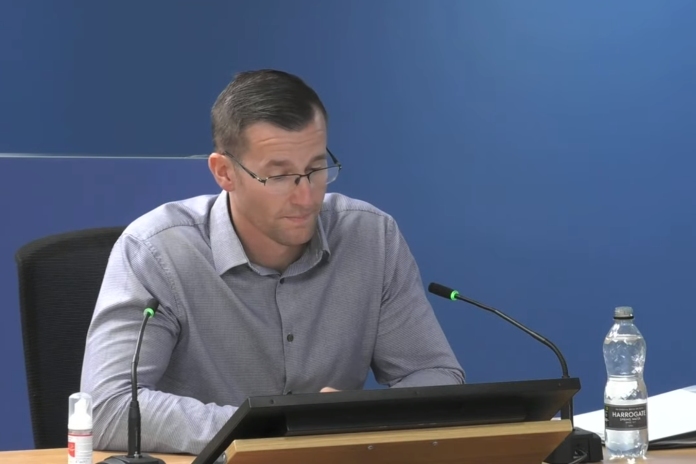
The former design manager of Harley Curtain Wall, the cladding subcontractor that work for Rydon during the refurbishment of Grenfell Tower, rejected the idea of two-hour fire stopping for the cladding as “ridiculous” because he expected it to melt and fall off the building long before that, the Grenfell Tower Inquiry has heard.
During his second day as a witness in the Grenfell Tower
Inquiry hearings, Daniel Anketell-Jones was asked by counsel Kate Grange QC
about a March 2015 email from Rydon contracts manager Simon Lawrence, on which
Anketell-Jones was not copied in. Lawrence said: “Harley via their supply chain
are questioning the rating of cladding firebreaks. Apparently by going to two
hours as we discussed has a cost increase of around £12,000. Their supplier is
saying it only need to be 30 minutes everywhere, as per the Regs below.”
This is not a paywall. Registration allows us to enhance your experience across Construction Management and ensure we deliver you quality editorial content.
Registering also means you can manage your own CPDs, comments, newsletter sign-ups and privacy settings.
Anketell-Jones replied: “Just that it’s ridiculous. There is
no point in ‘fire stopping’, as we all know; the ACM will be gone rather
quickly in a fire! The whole point is to stop ‘unseen’ fire spreading in the
cavity and moving to other parts of the building.”
Asked what he meant by the comment: “Just that it’s ridiculous”,
Anketell-Jones replied: “From my training with structural design, I knew that aluminium
façades were unable to resist a fire for very long at all and would just melt
and fall off the building. So putting in a two-hour firebreak on that kind of
façade was a waste of time.”
He added: “For the outside of the façades on any job, unless
it’s specifically required, they’re not required to stay on the building in a
fire. The failure mode for cladding in a fire is that it will melt and fall off.”
Asked what exactly it was about the ACM which would mean
that it would be gone rather quickly in a fire, Anketell-Jones said: “That it
was made from aluminium…That it would melt at a much lower temperature than
steel would…That basically the aluminium rails and the brackets that supported
them and the ACM would melt and fall off.”
When Grange asked Anketell-Jones if the core of the ACM panel
fed into his thinking when he made this comment, he replied: “No, not at all…I
was speaking generally across the whole cladding, including the ACM, the cladding
and the bracketry, from knowing how aluminium performs in a fire.”
Anketell-Jones added that his main focus at this point in
time was on another project. He said: “I was completely focused on another
project and being sent small little tasks to do on Grenfell. I didn’t have an
overall idea of what was going on.”
The January/February 2026 issue of Construction Management magazine is now available to read in digital format.
Powered Access
CM, in partnership with IPAF, has launched a new survey to explore the industry’s views and experiences with powered access machines on construction projects.
This is not a first step towards a paywall. We need readers to register with us to help sustain creation of quality editorial content on Construction Management. Registering also means you can manage your own CPDs, comments, newsletter sign-ups and privacy settings. Thank you.