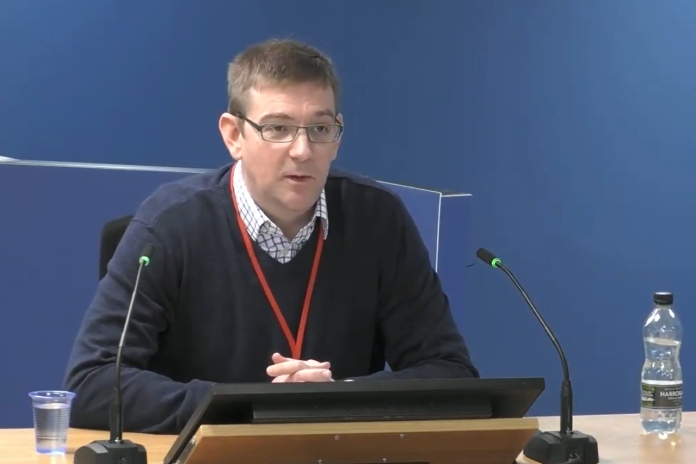
Jamie Hayes started working for Celotex in a temporary administrative role in 2004 before becoming a technical services officer. Despite the role’s title, Hayes did not have any technical qualifications and described the role as a customer support role within the marketing team where he would answer questions about the suitability of products for a particular application, as well as calculating U-values. He offered technical support to product manager Jonathan Roper in his efforts to launch RS5000 as a product suitable for buildings above 18m.
Hayes was asked about a BRE report produced after the
second, successful BS 8414 test of RS5000, which omitted details of the 6mm
magnesium oxide board placed adjacent to the fire barrier to help it pass. The
detail was also omitted from a draft report.
Hayes asserted that the decision was made by Celotex that
the presence of the magnesium oxide would not be referred to in the report.
Lead counsel to the Inquiry Richard Millett QC asked Hayes
if, given that the presence of the material wasn’t identified in the BRE’s
draft report, it meant Celotex had made a decision not to correct the draft so
as to provide a complete description of the system, or if he thought there had
been prior agreement that the draft shouldn’t contain reference to the magnesium
oxide.
Hayes replied: “Well, the short answer is: I don’t know.”
He added that he could not recall any discussions he had had
with the BRE’s Phil Clark or anyone else from that organisation about the omission
of the 6mm magnesium oxide board or the 8mm of Marley Eternit cladding that
covered it.
But Hayes suggested that Clark would have known the detail
had been omitted because Celotex had asked him to remove a photo from the
report which showed the magnesium oxide.
In a 1 July 2014 email, attached to the first draft of the test
report dated 2 June 2014, Celotex product manager Jon Roper asked Clark: “Could
you also replace figure 18 with the attached photographs as we want to show a
close-up of the condition of our insulation below and above fire break with the
intumescent fired off.” The email copied in Celotex head of marketing Paul
Evans, as well as Hayes himself.
Millett asked: “Now, when you saw this email did you
understand that Jon Roper was asking the BRE to remove what, on the face of the
report, was the only element of the report which showed the presence of the
magnesium oxide layer?”
Hayes replied: “Yes, I did.”
Asked about the background of the request, Hayes said: “My
memory isn’t brilliant, but I have a memory of being upstairs in possibly Jon’s
office and Paul Evans was there, they were discussing the photograph and the
reasons for the removal of that photograph, and I think it was because it
clearly showed the missing material which they didn’t want to appear in the
report, and that the purpose of asking Phil to remove that photograph was for
no other reason than to remove a photograph which was, I think, a dead
giveaway, if you like, that that missing material was on the test rig.”
Hayes said he did not have a separate discussion with either
Roper or Evans about the request but that it was clear from the email that Evans
was aware of it.
Hayes said: “I think he absolutely knew exactly what that
was, and I would imagine that it would have been -- well , I don’t know, and I
don’t want to, again, say things that I don’t know, but my understanding and
everything of how Paul had been the ultimate decision-maker up until then, that
would lead me to believe that he would have asked Jon to do that. And again,
there’s absolutely no doubt in my mind, based upon that conversation which I
witnessed, that Paul was completely aware of the reason for that photograph
being asked to be removed, and I think it’s most likely that actually he had
asked Jon to do that.”
In his evidence earlier this week, Evans denied being aware
of the presence of magnesium oxide in the test rig until 2017.
In his evidence on Monday (16 November), Roper said he was “fully
aware” that the rig was being “overengineered to achieve a pass” and that he had
altered presentation slides about RS5000’s successful test to remove references
to magnesium oxide at Evans’s request.
Millett asked Hayes: “Was it your view or understanding at
the time that Celotex was engaged in a deliberate attempt to create a
misleading test report?”
Hayes replied: “Yes. That’s exactly what was happening.”
Millett asked: “Were you concerned about that?”
Hayes responded: “I was very concerned about that.”
Asked why he did not challenge it, he said: “It’s not an
easy question to answer. My understanding was, and now, is that a decision had
been made by the senior management of Celotex. I didn’t know who I should speak
to or who I could speak to. I lacked, I guess, the life experience to find the
right way forward, and it was a failure of courage and a failure of character
and a failure of moral fibre on my part not to do so.”
Second test arranged “incredibly quickly”
Hayes also told the Inquiry that he saw the rapid
arrangement of a second test for RS5000 in May 2014, after it failed in February
2014, as an indication of the pressure the company was under to develop new products.
Hayes agreed that Celotex became more marketing-driven after
the business was acquired by Saint-Gobain in 2012 and that there was increased
pressure to develop new products.
While he did not feel personal pressure to do his role
differently, Hayes said he saw pressure on others, for example as part of the “18m
project”.
He told the Inquiry: “After the first 18m test failed, a
second test was arranged incredibly quickly and although it didn’t seem strange
to me at the time, I look back on that now and think it’s almost unbelievable
that I think only a few months passed between the failure of a major test and
how quickly a second test was arranged, authorised, paid for, and not to mention
the fact that…you would have top actually build a rig, which is to say have all
the materials, have someone construct it….How quickly they turned around
between 1 to 2 I think illustrates quite well that they were not prepared to wait
any longer than was humanly possible to progress that project and I guess the
ultimate goal of that project was to have a product which could be sold to increase
profits.”
In an opening statement given by Celotex at the start of
module 2 of phase 2 of the Inquiry, it said: “Celotex recognises that the
matters which emerged during its investigations involved inappropriate and
unacceptable conduct on the part of a number of employees. This was of real
concern to Celotex’s current management. Some of the employees involved had
already left the company. Those who remained were the subject of disciplinary
proceedings. Six employees resigned between December 2017 and March 2018.”
Samantha Leek QC, counsel for the BRE, said in her opening
statement that the testing house had “no involvement” in assessing the safety
of cladding systems installed on the tower.
Leek said: “BRE is not a regulator and does not fulfil the
function of a building control authority. It has no mandate, role or authority
to monitor what manufacturers and suppliers do with their test and
classification reports, and has no oversight as to how they are used to fulfil
their obligations under Building Regulations. BRE’s function is that of a test
house; in short, to burn systems and products and assess how they perform.”
The Inquiry continues.