












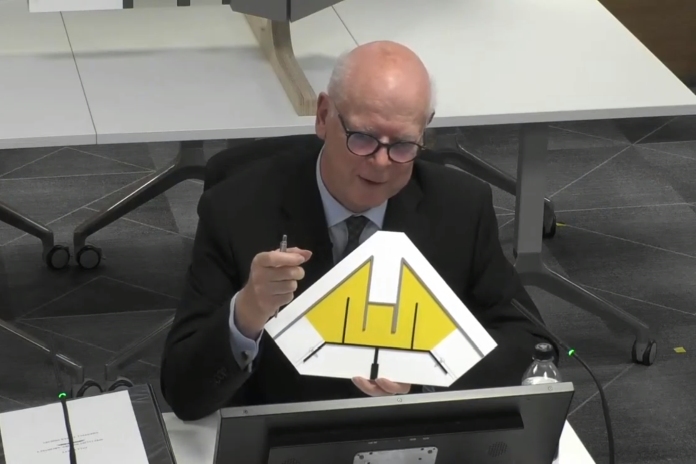
The design and build process is creating “disorder” within the construction industry, according to an expert witness at the Grenfell Tower Inquiry.
Paul Hyett, a former president of the Royal Institute of British Architects (RIBA), said that design and build contracts create huge time pressures for architects when developing a project’s design and specification.
“I’ve mentioned in my report the dangers of condensing, I would use the word ‘crushing’, decision-making into such a short time,” he explained.
“When I began my career – this is not a history lesson – the process of developing a design and specification was very orderly and took longer, or more time was given upfront. We now have a situation, through design and build, where there is disorder – I made that clear in my report – where later stages can be done before earlier stages.
“The presumption would have been that they would have been done earlier. But if the architect is trying to deal with the interior of the building, trying to deal with the cladding, trying to deal with a range of components going into the cladding, there’s sudden late changes coming in from the design and build contractor, then there would be limited amount of time that can be spent.
“And it’s for that reason it’s very important, I think, that the design team are assisted by those who certify and those who manufacture with information which is clear, in the interests of not having terrible outcomes.”
‘Unsatisfactory situation’
Hyett also described the circumstances following Rydon’s appointment as main contractor, where architect Studio E was novated to it, and fire consultant Exova was no longer retained but still provided “ad hoc” advice on the project as an “unsatisfactory situation”.
The Inquiry heard in earlier sessions how Exova had previously produced a draft fire strategy for the Grenfell Tower block, which stated: “The proposed changes will have no adverse effect on the building in relation to external fire spread. This will be confirmed by an analysis in a future issue of this report.” However, no future report was ever produced.
Lead counsel to the Inquiry Richard Millett QC asked Hyett: “From the prudent architect’s point of view, having been, as it were, novated now to Rydon, would that prudent architect be entitled to expect Exova to continue to fulfil its obligations under its appointment to the TMO and continue to provide advice up to the end of its retainer at stage F?”
Hyett replied: “I think I can best answer that by saying this is a pretty unusual and unsatisfactory situation. I don’t know how unusual it is, actually. Again, I’ve never done an audit of that. But it’s a pretty unsatisfactory situation, and I think that the architect, in terms of the safety of the project and responsibility for the project and to his new client, needs to make sure that this matter is dealt with.
“So perhaps the architect should speak to the contractor client and say: ‘Will you give me authority to go and speak to the TMO and make sure that we have an ongoing arrangement with Exova, informal as it might be, that allows us to get the information we need?’ But this needed to be closed out.”
Millett asked: “When you say this needed to be closed out, what’s the ‘this’?”
Hyett replied: “The many times repeated two lines.”
Millett said: “Yes. So the production or confirmation through an analysis in a future issue of this report?”
Hyett replied: “Yes, which in themselves have a horrible ambiguity in the line anyway, but we know what we’re talking about, yes.”
Millett went on to ask: “In your experience and in these particular circumstances, again from a prudent architect’s point of view, would you expect a design and build contractor or a client in the position of TMO to ordinarily ask the architect to make sure that the specialist fire safety engineer had the information necessary to be able to deliver the advice up to stage F?”
Hyett said: “The design and build contractor is offering himself as a design and build contractor – not just any contractor, a design and build contractor – with management skills. They’re going to manage the ongoing process of design development. I think that they should have taken the driving seat here and ensured that a proper audit was done on the employer’s requirements documentation to make sure that it was complete and that any gaps were identified and instructions were given to fill them. So I think that is my answer, yes.”
Value engineering
Millett also asked Hyett about whether or not, by 2012, the phrase “value engineering” had become a euphemism for “cost-cutting”.
Hyett said: “Difficult to make a generalisation. Many design and build contractors are highly competent and highly responsible and will interrogate a design with great effect and find cheaper but not worse – less expensive is a better term – less expensive ways of doing something. That is value engineering, and that’s very useful, and I don’t want to give an answer that would dismiss the good quality work of many, many good design and build contractors.”
Millett continued: “Leaving aside the question of whether the words ‘value engineering’ had become a euphemism for cost-cutting, do you detect in your work, looking back on the period, that the principles behind value engineering had become compromised, such that people then approached the concept of value engineering without adequately taking into account the importance of maintaining functionality and performance?”
Hyett replied: “I have a sense that that’s taken place. I don’t want to offer a holier-than-thou response, but I have a sense that that has been a pressure within the industry, but I don’t have any direct experience of that. Those that I have worked with have taken the work immensely responsibly. I’ve never been under pressure to compromise safety or anything like that by contractors who are bringing great pressure to bear in terms of achieving greater cost efficiency. But I have a sense that that is prevalent in the wider industry. But it is only a sense.”
Hyett’s final day appearing before the Inquiry also marked the end of ‘module 1’ of the second phase of the Inquiry. Module 2, which begins with opening statements from organisations including Arconic, Celotex, Kingspan, the British Board of Agrément, the Fire Brigades Union, and the Mayor of London, begins today (5 November).
Comments
Comments are closed.


It’s a typical comment that design and build create disorder.
This form of contract when managed correctly by Construction Professionals that understand the process offers Clients better value for money than traditional contracts. Early engagement of the DB contractor and their Design Team to the risks of the Project, either cost, Town Planning and build programme has proved time and again the best formula.
The current process whereby a contractor becomes what is called a Design & Build contractor but in fact is not a ‘Design & Build Contractor’ but merely a Design Development Contractor. Generally most of the design has been done and the contractor is contracted as a Design & Build Contractor to take on the risk.
True Design & Build Contractors where Architects, Engineers, all the professionals required to produce a Design and Build it were employee’s of the contractor were killed off by the Architectural profession during the late 1980s downturn.
The current Design & Build contract now is merely a tool to pass the risk onto the contractor.
Design and Build is a very effective procurement strategy if it is used in the correct type of construction project with clients, contractors and specialists all familiar with their roles and responsibilities and preferably when the parties have a reasonable experience of working with each other.
Problems occur when the above is not the case and it strikes me that this was the situation in the Grenfell project.
Design and Build tendering is not compatible with competitive tendering if an Employer wishes to have say over what is to be achieved. I am afraid Architects have to take responsibility for their designs and specifications throughout the whole process. The modern procurement processes work against that but I am afraid how it operated thirty years ago worked.
My experience of design and build contracts is they are frequently selected for projects that are unsuitable for them.They transfer the risk to the contractor which is rarely adequately priced leading to the search for cost savings once the contract is awarded. The value engineering process should be part of the design development not a means of trying to recover losses or increasing profits post contract. Value engineering is not a euphemism for cost cutting it is the definition of it. But it does not mean the selection of a lower specification to the detriment of the building quality.