












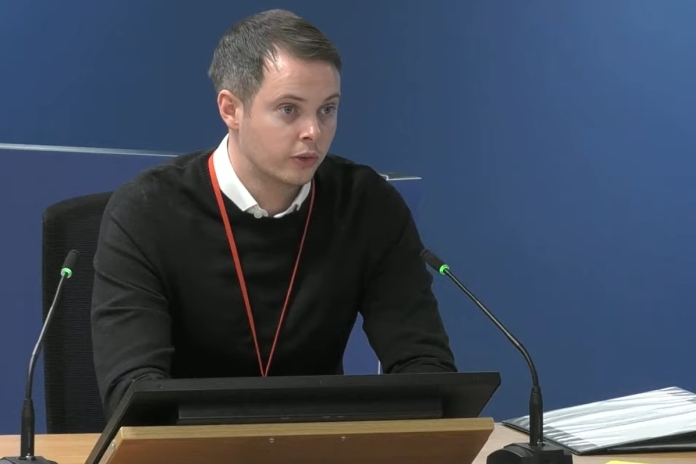
Action taken by Celotex at the time it was developing a marketing strategy for a new form of panel insulation that eventually ended up being used in the Grenfell Tower refurbishment were “completely unethical” the Grenfell Tower Inquiry has heard.
Former product manager Jonathan Roper agreed that it was “dishonest” to attempt to conceal the presence of magnesium oxide board used in a fire test of the RS5000 product, which was marketed as being suitable for use in buildings above 18m.
RS5000 initially failed a BS 8414 test (fire performance of external cladding) carried out in February 2014 and in order to ensure that it passed a second test in May that year, Celotex change the build-up of the system tested. The successful test used a system that at certain levels (adjacent to the Lamatherm fire barrier and at the top of the rig) used an 8mm Marley Eternit cladding panel, immediately behind which was a 6mm magnesium oxide board. 12mm Marley Eternit cladding panels were used on the remainder of the rig.
Lead counsel to the Inquiry Richard Millett QC asked Roper if the use of the thinner 8mm layer of cladding panel was “so as to conceal the 6mm magnesium oxide board to anybody either looking at the rig or a photograph of the rig in a later report”.
Roper replied: “It was to prevent any stepping out of the rig.”
Millett said: “Yes, and therefore to see off any prospect of anybody asking questions about why there was a step-out, as you put it?”
Roper replied: “Correct.”
Millett asked Roper if the action struck him as “dishonest”. Roper agreed that it did. Millett asked: “But you went along with it?”
Roper said: “I went along with a lot of actions at Celotex that, looking back on reflection, were completely unethical, and one that I probably didn’t potentially consider the impact of at the time. I was, as we’ve said, I was 22, 23, first job. I thought this was standard practice, albeit it did sit very uncomfortably with me.”
Roper confirmed that the reason for using magnesium oxide at the fire barriers was that one of the criteria for classification to BR 135 (Fire performance of external thermal insulation for walls of multistorey buildings) is that the temperature at the level 2 thermocouples should not exceed 600C.
He said: “I was fully aware at that stage that the rig was being overengineered to achieve a pass.”
Altered presentation slides
Millett also questioned Roper about a Celotex management action group (MAG) meeting in May 2014, the purpose of which was to brief former managing director Craig Chambers about the May test. Roper prepared slides for colleague Paul Evans to present but did not attend the meeting.
Roper’s slides detailed the two tests of RS5000 and the build-up of each system, noting that the first test failed but the second, which used 6mm of magnesium oxide at the thermocouples and thicker, 12mm Marley Eternit cladding elsewhere, passed.
Roper sent Evans the slides and, in his witness statement issued prior to the hearing, claimed that following the board meeting presentation he was asked by Evans to create another version of the presentation which did not refer to the February test or to the 6mm magnesium oxide. Evans told him this shorted version was for “general business use”, Roper claimed.
Millett asked: “Can we then take it that it’s your evidence, as far as you recall it, that everybody at that MAG meeting was aware of the differences between the build-up of the failed February 2014 test and the build-up of the successful May 2014 test?
Roper replied: “Yes.”
Millett asked Roper if it was his impression that “the decision to use a shorter slideshow without the 6mm magnesium oxide was an MAG decision which had been communicated to him which he [Evans] was then communicating to you, or whether it was simply his decision as a result of what he picked up at the MAG meeting”.
Roper said: “I think it was the first of those.”
The shortened version of the slides subsequently contained no mention of the magnesium oxide board and no mention of the 8mm Marley Eternit cladding either.
Asked if the omissions were designed to mislead the reader into thinking the build-up listed was the actual build-up tested, Roper replied: “Correct, yes.”
Millett said: “In fact, you knew at the time, surely, that this slide was downright misleading?”
Roper said: “Yes, I did.”
Millett added: “And intended to mislead?”
Roper replied: “Yes.”
Millett asked: “Did you realise at the time that if this was how the test was to be described to the market, it would be a fraud on the market?”
Roper said: “Yes, yeah, I did.”
Millett said: “Did you not feel at the time a sense that that was wrong?”
Roper said: “I felt incredibly uncomfortable with it. I recall going home that evening. and I still lived with my parents at that time and mentioned that to them, and I felt incredibly uncomfortable with what I was being asked to do.”
He added that he did not feel there was anyone within Celotex who he could go to with his concerns.
Celotex opening statement
In an opening statement to module two of phase two of the Inquiry, Craig Orr QC, representing Celotex, said that following the Grenfell Tower disaster, Celotex suspended the sale of RS5000 and under managing director Dean O’Sullivan, who was appointed in May 2016, the company discovered “certain matters” relating to the testing, certification and marketing of Celotex’s products that the current management was unaware of.
“Once established, these matters were promptly announced by notices on Celotex’s website and reported to the relevant authorities, including testing and certification bodies, the Ministry of Housing, Communities and Local Government, Trading Standards and the Metropolitan Police. In addition, Celotex made a full report of these matters to the Inquiry,” Orr said.
He went on: “It conducted extensive due diligence in relation to the testing of its products, and it commissioned additional fire safety testing of both its 4000 and 5000 ranges of insulation. That testing confirmed that those products achieved the classifications that they were stated to have at the time of the Grenfell Tower refurbishment.
“Celotex recognises that the matters which emerged during its investigations involved inappropriate and unacceptable conduct on the part of a number of employees. This was of real concern to Celotex’s current management. Some of the employees involved had already left the company. Those who remained were the subject of disciplinary proceedings. Six employees resigned between December 2017 and March 2018.”
The Inquiry continues.


