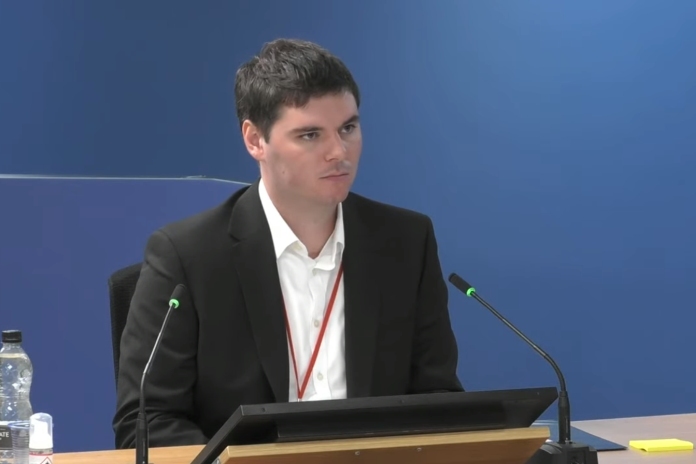
Ben Bailey, now aged 30 and the son of Harley director Ray
Bailey, admitted in a Grenfell Tower Inquiry hearing yesterday that he was
never given any training nor had any qualifications in relation to fire safety
in the construction of buildings.
Ben Bailey said he started working for Harley “on and off”
during school and university holidays. He started studying a foundation degree
in motorsport engineering but ended up moving on to business and management
instead. He started working on the Grenfell project in February 2015, with only
a few months’ worth of experience working in a similar role on a previous
project.
This is not a paywall. Registration allows us to enhance your experience across Construction Management and ensure we deliver you quality editorial content.
Registering also means you can manage your own CPDs, comments, newsletter sign-ups and privacy settings.
Ben Bailey said that he didn’t think his was an “overarching” role, but involved managing the programme, managing suppliers and directing the design in terms of what Harley needed to fulfil, as well as ensuring works were on time and to a high standard.
He added that he did not remember being involved in any
aspect of whether the design or the products complied with the Building
Regulations or industry standards like the CWCT standard.
Lead counsel to the Inquiry Richard Millett QC asked Bailey:
“Do I take it from what you’re telling us that you didn’t think you personally
needed to understand the regulatory framework – so Building Regulations,
Approved Document B and relevant industry guidance, in order to carry our your
role properly as project manager?”
Ben Bailey replied that he did not. Millett asked if this meant that as project manager, Bailey could not properly inspect the installation of cavity barriers by Harley or its subcontractors without knowing the requirements of Approved Document B. But Bailey replied: “My role as project manager, as I understood it, wasn’t to be inspecting such things… An inspection, in my mind, would be carried out by an independent third party. As I explained to you, I did snagging, which I see as a separate process to inspection.”
He also confirmed that Harley did not provide him with any
formal or internal competency training to keep him up to date with industry
codes of practice for the design and installation of cladding and windows.
Bailey said he saw it as the role of technical manager
Daniel Anketell-Jones to consider the fire performance of the materials and
design of the façade for Grenfell.
Millett pointed out that in a hearing last week, Kate Grange
QC asked Anketell-Jones who would be thinking about fire on the Grenfell project
and Anketell-Jones replied that it “would fall on Kevin [Lamb, freelance
designer] and Ben.”
Bailey said he disagreed with this assessment.
Celotex insulation discount
Millett moved on to ask Ben Bailey about what he termed the “hefty”
47.5% discount Harley obtained on the Celotex RS5000 insulation used on the
project.
Bailey said he did not have any “first-hand knowledge” of
how the discount was arrived at but that he was not surprised to see a discount
of that magnitude. And he denied that the fact Harley could get discounts of
this magnitude was something that influenced its choice of RS5000 as the
insulation product for Grenfell.
Millett highlighted an internal Celotex email from an
employee called Kirsty Crossley, sent in April 2015, which read: “Discussed the
potential to use as a case study and Ben is happy. Thinks that Rydons will get
on board also. Arrange to visit the next time in area.”
Bailey said he did not recall a meeting or the idea of a
case study for the RS5000 product being “discussed specifically”.
But he then added that in general terms he did recall discussions
with Celotex about Grenfell Tower being used as a case study for RS5000.
Asked if he got the impression that Grenfell was being used
as a “guinea pig” for RS5000, Bailey replied: “That’s not a thought that
crossed my mind.”
Turning to the classification of the product, Millett asked Bailey if he remembered seeing a document that told him that the classification for RS5000 was safe to use on buildings above 18m only applied to the system as tested and detailed in the classification report.
Bailey replied: “That’s not something I was aware of.”
Millett continued: “Were you aware in general terms that RS5000 would only comply with the Approved Document B to the Building Regulations where it was used above 18m if it was used as part of a cladding system that was exactly the same as the one the subject of the test?”
Bailey replied that he did not.
The Inquiry continues.