














The Building Cost Information Service (BCIS) has launched its Cost and Carbon Materials Database that can calculate cost and carbon values for more than 9,200 common building materials.
The new database, a development arising from BCIS’s work on the cross-industry Built Environment Carbon Database (BECD) launched last year, is compliant with the RICS whole-life carbon assessment standard.
It includes UK average merchant prices and outlines the effects of inflation, past and forecast, on the cost of those materials.
Materials have been assigned a representative environmental product declaration (EPD) where one is available. Where there is an inconsistency because different units of measure have been used in the EPD, BCIS provides the calculation and converted carbon value to use.
The database will enable users to consider whether they need to pay more for building materials with lower embodied carbon values, BCIS said.
It will also give professionals the ability to compare multiple product options side by side, alongside a 12-month inflation forecast on those costs.
The database will also enable the tracking of changes in cost and carbon values as a project progresses.
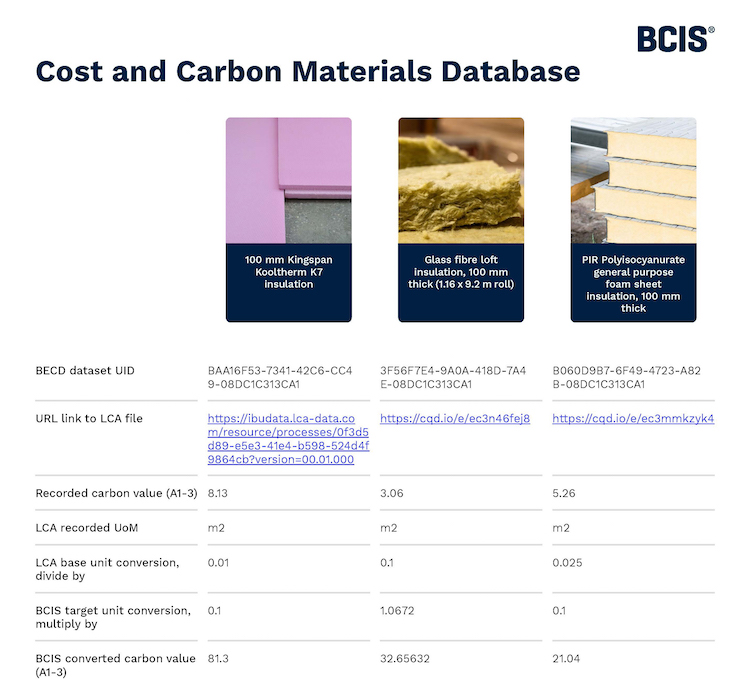
Addressing inconsistency
BCIS chief executive James Fiske said: “Having led on the development of the BECD, a free industry repository for the sharing of product and project carbon data, it really struck us how inconsistent the data can be.
“It’s all well and good saying that construction firms should be calculating and reporting on embodied carbon, because we know we have a mountain to climb in terms of reducing emissions from the built environment, but the practicalities of those calculations and trying to sift through the data to find what you need is far from straightforward.”
Fiske added: “When it comes to actually being able to make informed decisions, so you can properly assess the monetary and environmental costs of using one material or product over another, you can be tripped at the first hurdle because the units of measure for what you’re comparing aren’t even the same.
“The Cost and Carbon Materials Database is our first step to making those decisions much easier. As well as looking up current costs, which will be updated monthly, we also provide percentages for past inflation and a 12-month forecast, so you can see the bigger picture.”
This article first appeared on BIMplus


