Construction Management is the highest circulation construction-based publication serving the UK built environment.
News
Cladding remediation: why is progress so slow?
Three years on from the Grenfell Tower disaster, an
estimated 2,000 high-risk residential buildings still have combustible cladding
on them. CM asks why remediation work is taking so long.
More than three years have passed since the Grenfell Tower
disaster on 14 June 2017, but progress on replacing dangerous, flammable
cladding systems on high-risk residential buildings has been painfully slow.
The latest data available from the Ministry for Housing, Communities
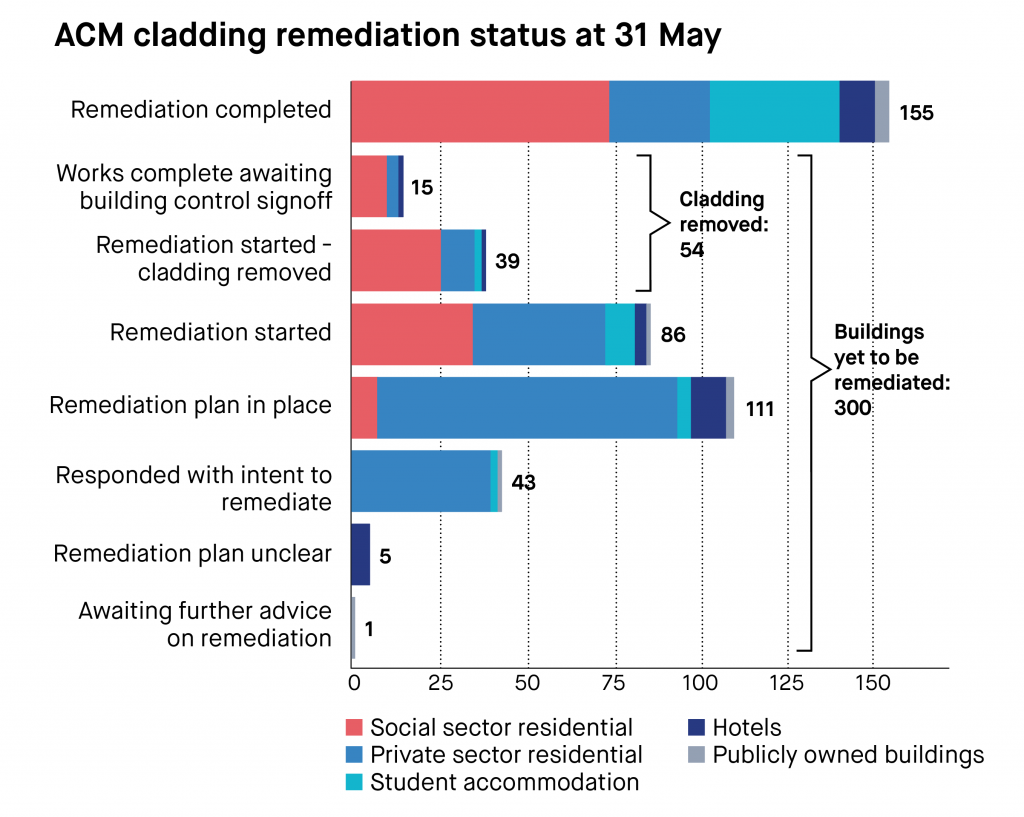
and Local Government (MHCLG) shows that there are 300 buildings with aluminium
composite material (ACM) cladding systems – the type used on Grenfell – that
still needed to be remediated, as at 31 May (see chart).
Some 155 buildings have had the remediation work completed
while another 54 have so far had their cladding systems removed. And that’s
just ACM cladding. According to a House of Commons report by the all-party
Housing, Communities and Local Government Committee published on 12 June, there
are another 1,700 high-rise buildings with other forms of combustible cladding
systems which need replacing.
This is not a paywall. Registration allows us to enhance your experience across Construction Management and ensure we deliver you quality editorial content.
Registering also means you can manage your own CPDs, comments, newsletter sign-ups and privacy settings.
“To still have 2,000 high-risk residential buildings with
dangerous cladding is deeply shocking and completely unacceptable,” said the
report, which also estimated that the overall cost of remediating all fire
safety defects from social and private sector residential buildings in England
could be as high as £15bn.
So, why has progress on cladding remediation been so
sluggish?
The government acknowledges in its monthly progress reports
that these projects can be complex and involve “major construction work which
needs to be planned, consulted on and carried out carefully”.
Helen Stuart, senior associate at law firm Trowers &
Hamlins, says that it can be a problem for building owners to identify from
their own records what materials were actually installed.
“Frequently the documentation handed over at completion is
incomplete or, in some cases, incorrect. This issue was picked up in the
Hackitt Report and the government’s consultation on ‘Building a Safer Future’
with the ‘golden thread of information’,” she says.
“There have also been challenges when it comes to the
availability of competent experts to advise building owners on fire safety
issues and the required remedial works, as well as difficulties with obtaining
sufficient professional indemnity insurance for some of these experts.”
In the private residential sector, progress has been much
slower than in the public sector. As of the end of May 2020, only 29 buildings
in the private sector had completed remediation works. Another 52 had started,
leaving 126 that had not even begun remediation.
Part of the problem, Stuart explains, is that some owners
have no other assets save for the freehold of the building.
“These companies rely on the service charge income to be
able to pay for any works to the building and so would not have been able to
fund any remedial works without recovering the majority of it first from the
leaseholders,” she says.
“Some time may also have been spent formulating claims
against third parties and looking to get the original contractors to undertake
the remedial works, or at least giving them the opportunity to do so.”
Unfortunately, the covid-19 pandemic has inevitably had an
impact too. Although the government
stressed in April that cladding remediation work remained a “priority” and
could continue if done safely, official data showed that 50% of the ACM
remediation projects paused works due to the virus.
“Hopefully, in the next data set we will see that more
projects have recom-menced in line with the construction industry generally,”
Stuart says.
The government’s response to the criticism is that it set
aside £400m in 2018 for social landlords to remediate high-rise buildings with
unsafe ACM cladding, and a further £200m last year for private landlords.
“Too many risks are being excluded by the criteria for
accessing this support and the amount of money pledged is only enough to cover
a fraction of the work needed.”
Clive Betts MP
It also announced a new £1bn cladding replacement fund at
the end of May for non-ACM cladding systems that are unlikely to meet Building
Regulations. This fund will be open to social housing landlords and private
sector residential building owners and freeholders where the cost would
otherwise be passed to leaseholders through the service charge.
Interestingly, the fund will not be available for
remediation works which had already been committed to, or had started, prior to
11 March 2020, which Stuart notes is “unfortunate for those who were proactive
and quick to take steps”.
“There will be a separate claims process in July for a
contribution from government for registered providers with in-scope buildings
who cannot show their viability would be threatened by carrying out the works,”
she adds. “This will be a welcome development for the social sector, as it was
initially thought that no funding would be available if the works did not
threaten viability.”
With the new fund announcement, building safety minister
Lord Greenhalgh said: “Now that this additional £1bn funding is in place,
building owners must crack on with removing flammable cladding on all high-rise
residential buildings that are over 18m.”
Support ‘will fall short’
But there are questions over whether the funding provided
will be enough.
The report by the Commons Housing, Communities and Local
Government Committee warned that support “will fall far short of what is
needed” to deal with dangerous cladding as well as other fire safety issues
such as inadequate fire doors or missing fire breaks.
It said that the £1bn fund will only be enough to cover the
cost of removing non-ACM cladding from a third of the 1,700 buildings requiring
remediation and criticised “stringent rules”, including a short application
window and restrictions against social housing providers.
Committee chair Clive Betts says: “Too many risks are being
excluded by the criteria for accessing this support and the amount of money
pledged is only enough to cover a fraction of the work needed.
“The fund should be increased so that it is enough to cover
the amount of work that is actually needed, both to remove cladding and resolve
wider fire safety concerns. Further support must also be provided for the costs
of stop-gap safety measures, such as ‘waking watches’, to reduce the burden on
homeowners.”
The committee called on the govern-ment to ensure that “all
buildings of any height with ACM cladding should be fully remediated of all
fire safety defects by December 2021” and that “buildings with other fire
safety defects, including non-ACM cladding, should be remediated before the
fifth anniversary of the Grenfell Tower fire in June 2022”.
The January/February 2026 issue of Construction Management magazine is now available to read in digital format.
Powered Access
CM, in partnership with IPAF, has launched a new survey to explore the industry’s views and experiences with powered access machines on construction projects.
This is not a first step towards a paywall. We need readers to register with us to help sustain creation of quality editorial content on Construction Management. Registering also means you can manage your own CPDs, comments, newsletter sign-ups and privacy settings. Thank you.