












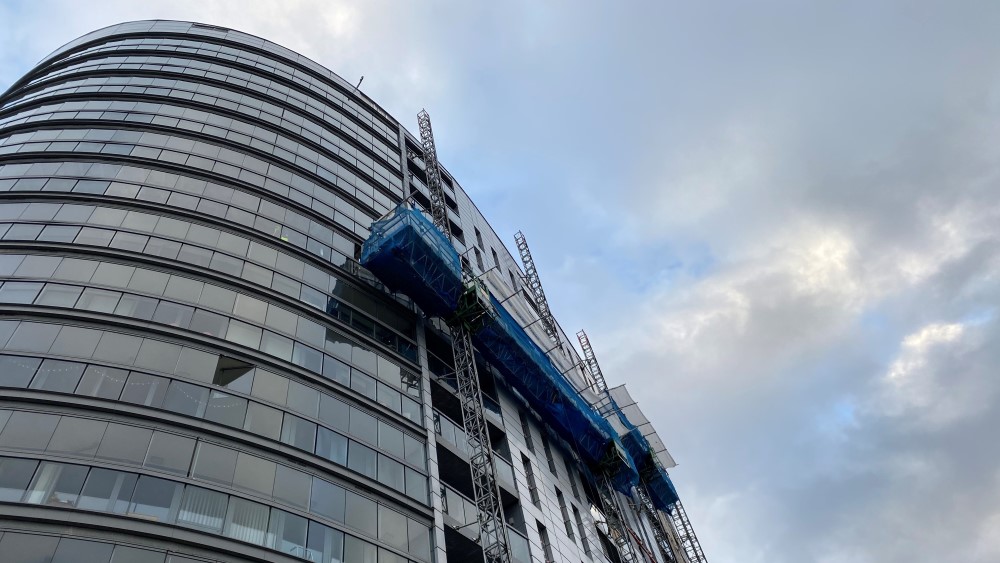
The Chartered Institute of Building (CIOB) has called on the government to commit to immediate action to protect tenants and leaseholders from having to foot the bill for remediation of unsafe cladding.
The call came after an Opposition Day debate on the matter yesterday (1 February) in the House of Commons.
A cross-party group of MPs voted to support a motion that urges the government to provide funding to fix unsafe homes and ensure that the financial burden of remediation does not fall on leaseholders and tenants.
The CIOB, which has been monitoring the issue of cladding and building safety closely, said that while the vote was not legally binding, it sent a “clear message” about the strength of feeling on the issue and a need to find a solution to protect leaseholders and those living in potentially unsafe buildings.
In a statement, the CIOB said: “While there is no doubt that it is a complex matter, with a long list of stakeholders, new figures from the New Build Database and the Office for National Statistics (ONS) indicate that up to 11 million people in the UK are impacted by this issue, living in accommodation that is potentially unsafe and, in many instances, faced with the prospect of a financial commitment to rectify something over which they had no influence or control. This is causing unnecessary distress to many and is clearly unacceptable.
A funding solution should not penalise leaseholders and leave them burdened with paying
“New proposals for a loan scheme may still lead to leaseholders bearing some costs being imposed on them by landlords. It is encouraging that there is political will across all parties to take further action, but the CIOB would like to see the government commit to act immediately.
“Government should prioritise the ongoing risk assessments regarding where aluminium composite material (ACM) may be present, confirm measures to make those buildings safe as soon as possible and find a funding solution which does not penalise leaseholders and leave them burdened with paying, even in part, for historical building safety remediation works, whilst ensuring that these costs are excluded from the proposed building safety charge.”
These were also amongst the key recommendations of the Housing, Communities and Local Government Committee (HCLG) pre-legislative scrutiny of the Building Safety Bill published last year, to which the CIOB contributed at the evidence gathering stage: Pre-legislative scrutiny of the Building Safety Bill. The government is due to formally respond to this report shortly.
The CIOB added: “It’s clear that, when there is more information from detailed risk assessments on the scale of ACM still present and more progress with the removals programme, the construction industry will be key in ensuring such a situation can never happen again. In the short- to medium-term, this means that replacement work is carried out to the highest standards.
“Over the longer-term, although the work has already started among key industry stakeholders, the need is to ensure that lessons are learned and, crucially, embedded across the sector, with a commitment to quality and safety present throughout the construction sector.”
Comments
Comments are closed.


Here’s a novel idea what about getting the companies involved in the first place who tried to save money or make bigger profits putting their hands in their pockets and paying for some of the remedials
My understanding is; the Leaseholder is responsible for the internal repairs/renovations to their individual properties (with the Building Owners consent) and the Building Owner is responsible for the structural and communal components.
The Government/Taxpayer isn’t responsible for the repair costs, the building Owner is. The government should pay to assist the Building Owner to make the buildings safe and claim the money back from the designers, specifiers and mostly, the supplier/manufacturer. The only costs the Building Owner should be charging the Leaseholders is their normal costs for ROUTINE maintenance etc., however, it seems some of them are charging excessively for fire watch wardens – are they trying to make a ‘fast buck’ out of the Leaseholders?