Construction Management is the highest circulation construction-based publication serving the UK built environment.
News
Cement-based batteries could create rechargeable buildings
CM Staff
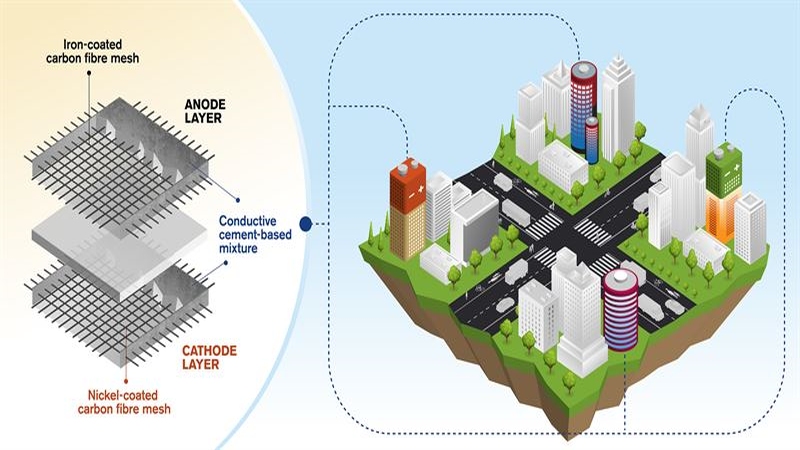
Image: Chalmers University of Technology
Researchers at a university in Sweden have developed a concept for rechargeable cement-based batteries.
Chalmers University of Technology has produced an outline article detailing the idea for a cement-based mixture, with small amounts of short carbon fibres added to increase the conductivity and flexural toughness. Then, embedded within the mixture is a metal-coated carbon fibre mesh – iron for the anode, and nickel for the cathode.
The researchers said they saw applications that could range from powering LEDs, providing 4G connections in remote areas, or cathodic protection against corrosion in concrete infrastructure.
This is not a paywall. Registration allows us to enhance your experience across Construction Management and ensure we deliver you quality editorial content.
Registering also means you can manage your own CPDs, comments, newsletter sign-ups and privacy settings.
Professor Luping Tang and Dr Emma Zhang’s research has produced a rechargeable cement-based battery with an average energy density of seven Watthours per square metre (or 0.8 Watthours per litre). Energy density is used to express the capacity of the battery. The University claimed that the performance of the new Chalmers battery could be more than ten times that of earlier attempts at concrete batteries. The energy density is still low in comparison to commercial batteries, but it said this limitation could be overcome thanks to the huge volume at which the battery could be constructed when used in buildings.
Dr Zhang said: “Results from earlier studies investigating concrete battery technology showed very low performance, so we realised we had to think out of the box, to come up with another way to produce the electrode. This particular idea that we have developed – which is also rechargeable – has never been explored before. Now we have proof of concept at lab scale.
“It could also be coupled with solar cell panels for example, to provide electricity and become the energy source for monitoring systems in highways or bridges, where sensors operated by a concrete battery could detect cracking or corrosion.”
The technology is still at a very early stage and technical questions remain to be solved before commercialisation of the technique can be a reality, including extending the service life of the battery, and the development of recycling techniques.
Dr Zhang said: “Since concrete infrastructure is usually built to last 50 or even 100 years, the batteries would need to be refined to match this, or to be easier to exchange and recycle when their service life is over. For now, this offers a major challenge from a technical point of view.”
But she added: “We are convinced this concept makes for a great contribution to allowing future building materials to have additional functions such as renewable energy sources.”
The January/February 2026 issue of Construction Management magazine is now available to read in digital format.
Powered Access
CM, in partnership with IPAF, has launched a new survey to explore the industry’s views and experiences with powered access machines on construction projects.
This is not a first step towards a paywall. We need readers to register with us to help sustain creation of quality editorial content on Construction Management. Registering also means you can manage your own CPDs, comments, newsletter sign-ups and privacy settings. Thank you.