Construction Management is the highest circulation construction-based publication serving the UK built environment.
News
Blood cells in concrete help seal cracks
CM Staff
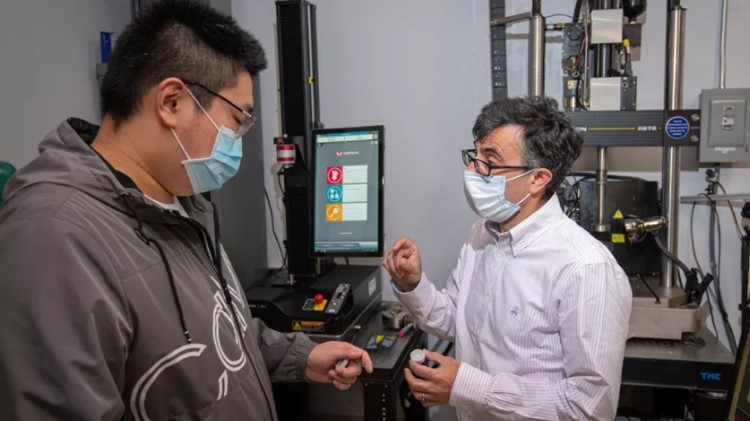
Image: Nima Rahbar (right) with a sample of the self-healed concrete (Courtesy of the Worcester Polytechnic Institute)
An enzyme extracted from blood cells can be used to make a form of self-healing concrete that is four times more durable than traditional formulae.
That’s the finding of a team of researches at the Worcester Polytechnic Institute in Massachusetts in the USA. The researchers say the carbonic anhydrase enzyme taken from blood cells reacts with atmospheric carbon dioxide to create calcium carbonate crystals that automatically fill cracks before they cause structural problems.
The work, published in the journal Applied Materials Today, details three concrete mixes. One will autonomously mend small cracks, a second can induce self-healing in larger cracks, and a third can be used to mend cracks that have already formed in traditional concrete.
This is not a paywall. Registration allows us to enhance your experience across Construction Management and ensure we deliver you quality editorial content.
Registering also means you can manage your own CPDs, comments, newsletter sign-ups and privacy settings.
Nima Rahbar, an associate professor of civil and environmental engineering at the institute, was the lead author of the paper, according to Global Construction Review. He commented: “If tiny cracks could automatically be repaired when they first start, they won’t turn into bigger problems that need repair or replacement. It sounds sci-fi, but it’s a real solution to a significant problem in the construction industry.”
He added: “We looked to nature to find what triggers the fastest CO2 transfer, and that’s the CA enzyme. Since enzymes in our bodies react amazingly quickly, they can be used as an efficient mechanism to repair and strengthen concrete structures.”
The process, which Rahbar has patented after five years of research, can heal millimetre-scale cracks within 24 hours.
To mend a bigger crack or hole, Rahbar said, calcium and CO2 can be applied to spur autonomous healing. The same mixture can be used, but with a different application process, to initiate healing in already-set traditional concrete.
The January/February 2026 issue of Construction Management magazine is now available to read in digital format.
Powered Access
CM, in partnership with IPAF, has launched a new survey to explore the industry’s views and experiences with powered access machines on construction projects.
This is not a first step towards a paywall. We need readers to register with us to help sustain creation of quality editorial content on Construction Management. Registering also means you can manage your own CPDs, comments, newsletter sign-ups and privacy settings. Thank you.