This is not a paywall. Registration allows us to enhance your experience across Construction Management and ensure we deliver you quality editorial content.
Registering also means you can manage your own CPDs, comments, newsletter sign-ups and privacy settings.
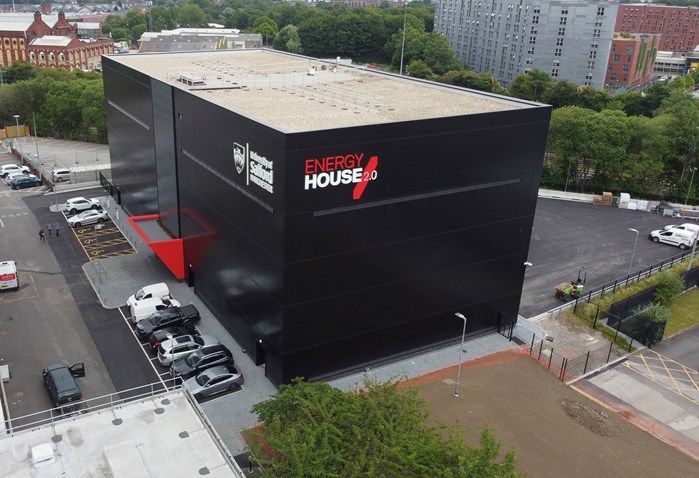
Salford University’s £16m testing facility is the largest of its kind in the world. It has two chambers which can accommodate two detached homes. The chambers can replicate weather conditions including rain, wind, snow and solar radiation, with temperatures ranging from -20oC to +40oC.
Range of sustainable products
The data gathered from eHome2 will help inform how the housebuilding sector will design and build properties to meet the 2025 Future Homes and Building Standard, and deliver low- and zero-carbon housing at scale, through the use of sustainable building materials and offsite solutions.
ehome2 is operationally net-zero carbon and features a range of sustainable building products from Saint-Gobain brands including British Gypsum, Isover, Saint-Gobain Glass and Weber. The house was built using modern methods of construction by Scotframe and Pasquill. It has an advanced timber-frame solution and factory-installed pre-insulated walls.
The home also features an air source heat pump, mechanical ventilation and heat recovery (MVHR) and centralised mechanical ventilation systems, PV panels and battery storage, heated skirting boards and infra-red panel heating. A key part of the research will be to establish how different combinations of heating, hot water and air handling systems, paired with the high-performing fabric of the home, can best deliver low running costs.
Critical challenges
Mike Chaldecott, chief executive of Saint-Gobain UK & Ireland, said: “Climate change, water shortages and resource scarcity are some of the most critical challenges of our time and construction must transform to meet these challenges.
“Creating eHome2 will produce a new blueprint for building homes en masse that are capable of operating at net-zero carbon level, consuming far less water and creating less waste. At times like this, with the cost of energy at a critical point, new modern methods of construction which see homes constructed offsite in controlled factory settings are essential to create sustainable, comfortable and efficient homes that will cost consumers far less to heat.”
Oliver Novakovic, technical and innovation director at Barratt, said: “We’re building high-quality sustainable homes today, as well as innovating and adapting our designs for the future.
“Building eHome2 within the Energy House is one of the most significant projects that Barratt has ever undertaken. Along with Saint-Gobain and the University of Salford, we’re leading the way to test the impact that extreme temperatures caused by climate change could have.”