















Welcome to the third instalment of BIMBox’s series on the development of WASTEie, a new dataset to standardise the exchange of construction and demolition (Cu0026amp;D) waste information.
As part of the Reconmatic projecthttps://www.reconmatic.eu/, in this third part of the WASTEie series, we focus on the pragmatic integration of information requirements into existing industry workflows, especially in the context of C&D waste management. This follows our initial exploration of potential waste streams and the subsequent development of a process map for material recycling and reuse.
Our journey began with the adoption of the IFC schema. IFC 4.3, with its latest advancements in rail and road domains and recent official recognition, appeared as a promising framework for defining parameters and information requirements. However, our analysis revealed gaps in its applicability to C&D waste management. The IFC schema, while extensive, falls short in areas critical for evaluating circularity, particularly in defining material properties pertinent to C&D waste.
To address these limitations, we propose the integration of additional property sets dedicated to C&D waste and material recycling through the use of buildingSMART data dictionaries. This approach not only fills the identified gaps in the IFC schema, but also maintains coherence with existing technological frameworks.
The buildingSMART Data Dictionary (bsDD) emerges as a vital tool in this context. As a comprehensive library of classes, properties, relations and units, bsDD offers a structured and standardised approach to data classification. Its API-first design enables seamless integration with software tools, making it an ideal platform for enriching the IFC schema. Key advantages of bsDD include:
- multi-software compatibility;
- structured data management to minimise errors;
- global applicability;
- synchronisation with the IFC schema;
- reusability of parameter definition; and
- integration with Information Delivery Specification (IDS).
Implementation
Coupling bsDD with the IDS, another standard by buildingSMART, enhances our strategy. Although IDS is still in development, its combination with bsDD is anticipated to streamline the process of capturing and verifying information related to C&D waste. This coupling has already been demonstrated in the industry by the likes of Plannerly, ACCO, and BlenderBIM.
The above theory sounds great, but how will we implement it? Our initial proposed implementation plan involves the following steps:
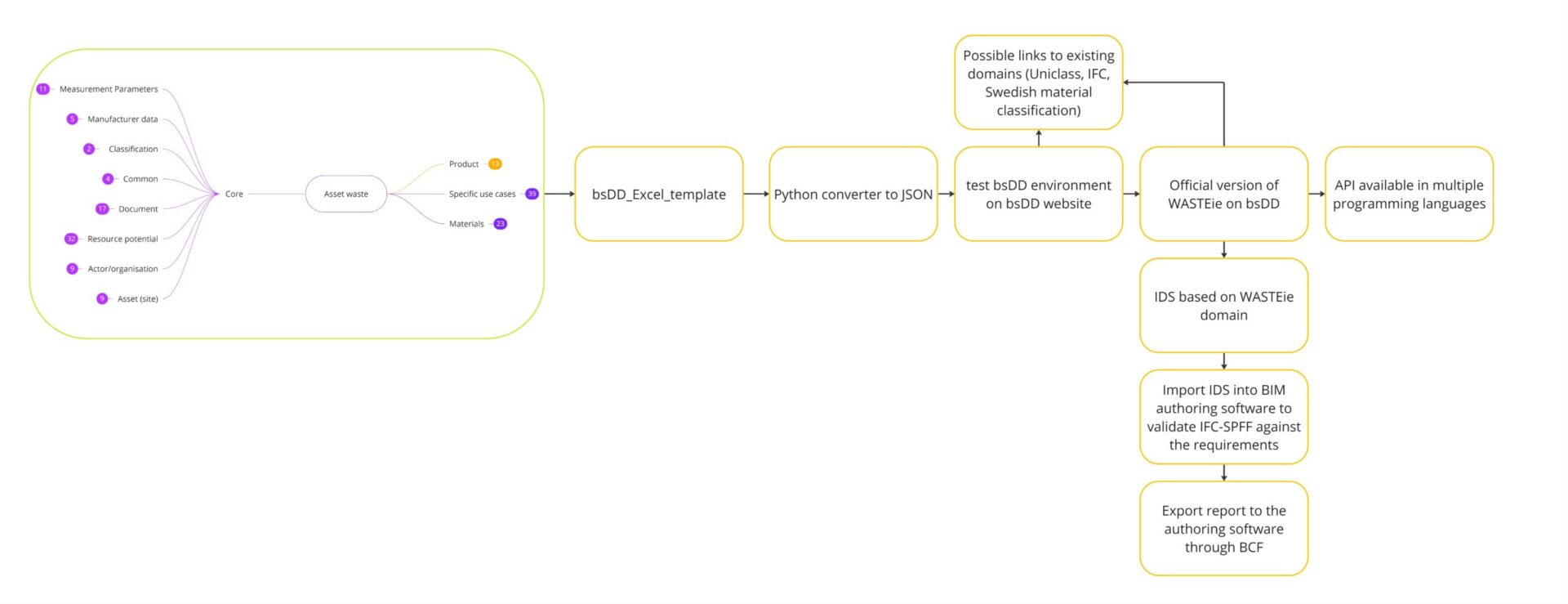
- Utilise the bsDD Excel template for capturing parameter definitions, classes, and property groups.
- Link these definitions to existing IFC parameters wherever applicable.
- Convert the Excel template into JSON using a Python script provided by bsDD team.
- Test the WASTEie domain on the bsDD platform to ensure accuracy.
- Publish the domain on bsDD for broader access and application.
- Develop IDS based on WASTEie definitions and align them with key project milestones and stakeholders, as per the process map.
- Implement and test IDS on actual projects, using BIM Collaboration File for reporting non-compliances.
By establishing a set of properties specific to C&D waste and sharing them publicly, we aim to provide a foundational resource for the industry. This initiative is expected to facilitate more efficient and sustainable practices in C&D waste management, contributing significantly to the broader goals of sustainability and resource optimisation in construction.
Vitalij Tetervov and Chris Crookes are R&D manager and managing director respectively of BIMBox, part of the Reconmatic consortium working to establish practical methods to better identify and minimise C&D waste during the entire lifecycle of a building.
Don’t miss out on BIM and digital construction news: sign up to receive the BIMplus newsletter.


