Construction Management is the highest circulation construction-based publication serving the UK built environment.
Technical
Three concrete technologies to watch
Kristina Smith Contributor
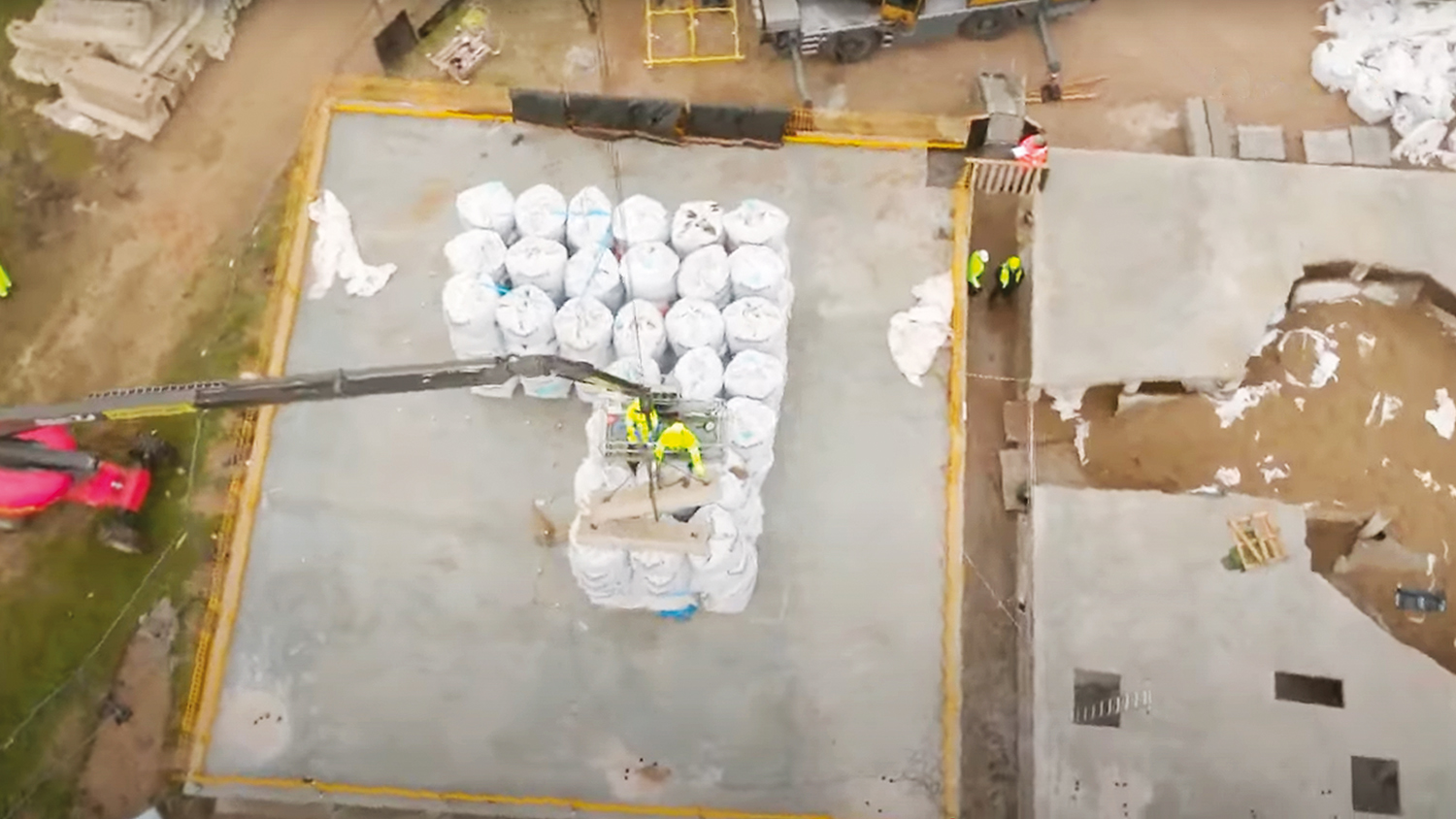
In a trial loading sandbags onto two concrete slabs, the self-stressed slab supported 33% more weight before collapsing compared to a traditional slab
Construction wants to improve its productivity and sustainability – and these emerging concrete technologies could be central to that.
Self-stressing concrete
Arriving in the UK from Latvia is a chemically self-stressing concrete, which contains a patented combination of three admixtures and steel fibres. Called PrīmX, the concrete has been developed by Primekss to be both stronger than conventional steel fibre reinforced concrete and non-shrinking.
A test comparing structural performance of a PrīmX floor slab versus traditional steel fibre-reinforced slab of the same thickness showed the traditional slab collapsing after 159 tonnes of sandbags were added, whereas the PrīmX slab did not collapse until 211 tonnes of sandbags had been loaded on.
This is not a paywall. Registration allows us to enhance your experience across Construction Management and ensure we deliver you quality editorial content.
Registering also means you can manage your own CPDs, comments, newsletter sign-ups and privacy settings.
Projects in Sweden and Denmark demonstrate how the concrete can be used without joints for the floor slabs of huge logistics and distribution centres. There are four Primekss-approved contractors in the UK.
https://www.youtube.com/watch?v=xNQqO1uQPZQ
Self-healing concrete
One of the most developed self-healing concrete technologies – by Basilisk, which came out of the Technical University of Delft – uses bacteria within the concrete to close cracks.
The bacteria are activated by water, multiplying and producing CaCO3 – limestone. Last year, contractor Heijmans Infra installed the self-healing concrete for the first time in the wall of an underground pump room for the Vijfeiken Tunnel in Rijen.
In the earlier stages of development is Mimicrete, which sees polymer-based tubing installed within concrete elements, which will rupture if the concrete cracks, releasing a healing agent.
The Cambridge University startup is working on a project at the Global Centre of Rail Excellence which will look at how the technology could be deployed in railway sleepers and retaining structures.
Recycled cement paste
Another Cambridge University spin-out, Cambridge Electric Cement, is progressing with its project to industrialise the conversion of recycled cement paste back into Portland Cement.
The cement paste – separated out from recycled concrete – is used as the flux material in an electric arc furnace (EAF) used for recycling steel.
After the first successful industrial trial at Celsa UK’s Cardiff EAF was announced in May 2024, the project raised £2.5m in seed funding in July 2024 from a group of investors focused on decarbonisation technology.
This means that Cambridge Electric Cement, Celsa UK and the other industry partners – AtkinsRéalis, Balfour Beatty, Day Group, Materials Processing Institute and Tarmac – can continue with the development of the low carbon cement.
The January/February 2026 issue of Construction Management magazine is now available to read in digital format.
Powered Access
CM, in partnership with IPAF, has launched a new survey to explore the industry’s views and experiences with powered access machines on construction projects.
This is not a first step towards a paywall. We need readers to register with us to help sustain creation of quality editorial content on Construction Management. Registering also means you can manage your own CPDs, comments, newsletter sign-ups and privacy settings. Thank you.