Construction Management is the highest circulation construction-based publication serving the UK built environment.
Digital Construction
The meaning of BIM is still unclear
Justin Stanton Editor, CM Digital
Image: Elena Abrazhevich | Dreamstime.com
The meaning of BIM is still unclear, according to the latest digital construction report from NBS in association with Glenigan.
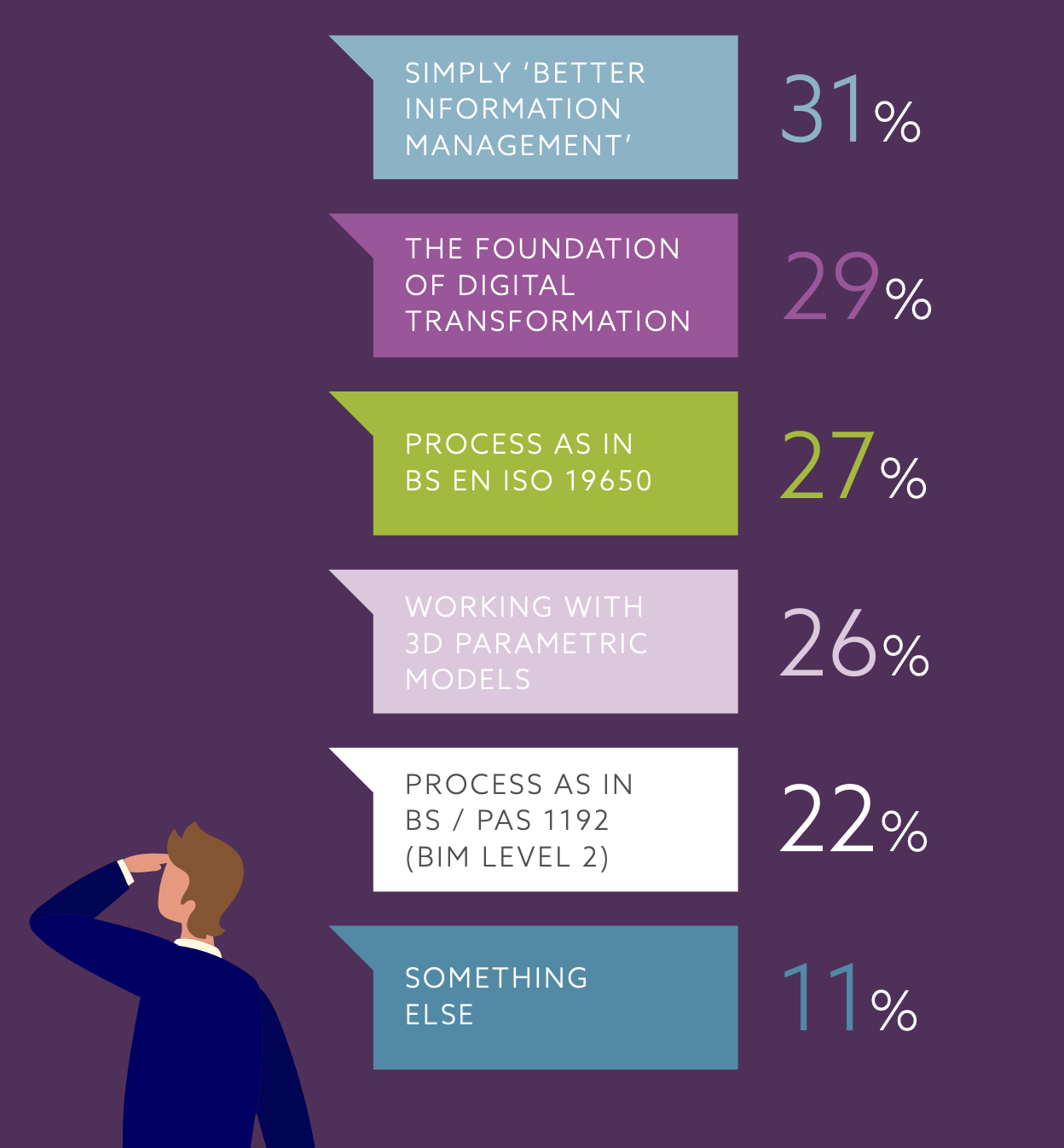
The more than 700 professionals (nearly three-quarters from the UK) in the survey were divided on the meaning of BIM. Asked “how would you describe BIM in 2023?” nearly a third (31%) said it was “simply better information management”, while a similar percentage (29%) thought it was the foundation of digital transformation. More than a quarter (27%) saw BIM as a process relating to ISO 19650, while a similar percentage (26%) saw it as working 3D parametric models. Nearly a quarter mentioned the outdated PAS 1192/BIM level 2 [respondents could pick more than one definition - ed].
Further analysis reveals that smaller organisations, of 25 staff or fewer (17%), are less likely to see BIM as following a set of standards. And, unsurprisingly, it’s the BIM specialists who are most likely to see BIM in terms of ISO 19650 (55%). They are also most likely to view it as better information management (38%) and the foundation of digital transformation (41%).
This is not a paywall. Registration allows us to enhance your experience across Construction Management and ensure we deliver you quality editorial content.
Registering also means you can manage your own CPDs, comments, newsletter sign-ups and privacy settings.
How do you describe BIM in 2023? (graphic courtesy of NBS)
BIM adoption levels are static at 70%. Since 2018, NBS’s survey results show adoption levels varying between 69% and 73%. There are some differences between roles in the latest survey, with adoption rising to 73% among consultants while, perhaps unsurprisingly, it is lower (53%) for clients.
Size matters
There remain large differences relating to organisation size: BIM adoption drops to 60% among organisations with 25 or less staff, and 56% for those with 15 staff or less. Age has an impact too, with those over 55 less likely to have adopted BIM (59%), and more likely to have no plans to (22%).
An architectural assistant at a medium-sized architectural practice told NBS: “I think there is generally a knowledge gap between senior construction professionals and junior staff using BIM software full-time, making it harder to calculate the level of resource required to deliver a certain level of [detail/information]. If BIM as a process was more inclusive of all team members, especially in small to [medium-sized] businesses, everyone might better understand what they’re signing up to when they take on contracts with BIM as a deliverable.”
NBS said: “There are some who feel that much of the industry has now adopted BIM, implying that there is a limited need to continue discussing it. However, the many comments in this survey debating its effectiveness, and that of digital technologies generally, suggest that it is still very much a live discussion.
“While a lot of work has gone into mapping out a process that many have followed, often on large projects, the challenge now is applying the right version of it effectively on projects of all types and sizes, and in a way that benefits all the project team, and the full range of construction projects: large and small; new and refurb; and conservation, landscape, infrastructure and buildings.”
Sharing information
Over three-quarters of respondents (77% – up from 73% in the last survey) said that their organisation follows a naming convention for all information that is shared. More than half (56% – up from 50%) exchange information in IFC, and 36% (up from 31%) in COBie. There was an appreciable increase in those using NBS’s Uniclass classification system: 39% of respondents to 49%.
NBS also asked respondents about how digital technology is being used to calculate specific metrics relating to environmental sustainability. More than two-thirds (67%) stated that they use digital tech to calculate at least one metric: most commonly, these are embodied carbon (40%) and energy demand (38%). Almost a third (32%) use it to undertake lifecycle analysis, and just under a fifth to calculate water use demand (19%) and waste (18%).
Immersive technology was also under the microscope. More than a third (36%) said they already use some form of immersive technology, while another 20% plan to use it within three years.
Of those already using immersive technology, nearly three-quarters (74%) are using it for stakeholder engagement such as walk-throughs. Nearly two-thirds (62%) are using it to visualise how designs interface with their surroundings. More than half are using immersive technology for clash detection during design and construction.
This is not a first step towards a paywall. We need readers to register with us to help sustain creation of quality editorial content on Construction Management. Registering also means you can manage your own CPDs, comments, newsletter sign-ups and privacy settings. Thank you.