














By now BIM should be a greater success, says Jason Ruddle, software company Elecosoft’s chief operating officer.
I will say what many others may be thinking: that the long-awaited NBS National BIM Report 2016 does not present BIM as the success it should be by now. Just 54% of respondents are aware of and using BIM – with a small number who still, somehow, know nothing. Although 97% of people that say they’ll be using it within five years and 86% within one, that’s not ideal when many need to be using it already.
The survey base is a little concerning also, with more than 50% being either architects or architectural technologists – the group with the longest exposure to BIM-type approaches. A third concern is that it suggests we don’t yet see ourselves as BIM leaders, which is worrying, given that the ambition is to lead unified adoption in Europe.
The standards usage breakdown is fascinating. PAS and BS standards hold the detail of what it takes to “do BIM” and should be helpful, but are being patchily utilised. Is this also skewed by the architectural base? Perhaps: the RIBA Plan of Works has good penetration. Since others support less-represented stages, perhaps this is why usage is lagging.
Despite constant BIM Task Group communications, certain facets seem to still fail to resonate. Many don’t know or trust the cost efficiencies and potential to increase profitability BIM brings – or that it might expand a company’s international reach. Worryingly, 21% think BIM is about software and 25% that it is just for large companies. Some of the £15m earmarked for the government’s Digital Built Britain strategy announced in the budget might be well used to correct such misperceptions.
Are we at a critical stage for BIM adoption? Of course, since we are now into the “live” phase for public projects. Are these figures unreliable? Absolutely not, they are insightful, and the authors have been diligent in cautioning readers about the survey base balance. It is, however, a shame that, despite efforts in areas such as civil engineering, structural engineering and manufacturing, these aren’t showing through in what is positioned as a national report. The picture may be rosier than it appears.
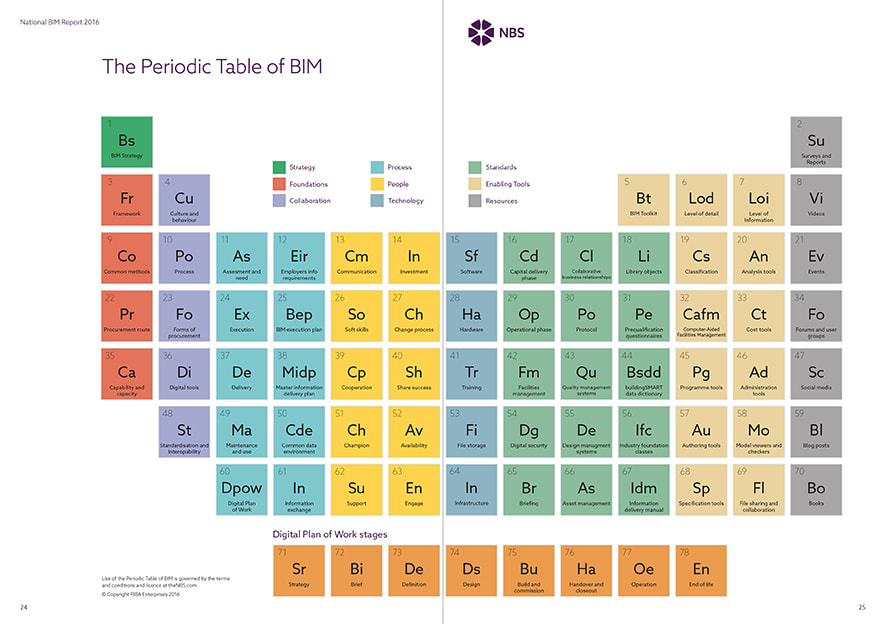
What we should all do is take the positive and useful insights of this key report, but do so with thought. It provides a good overview of the dynamics of BIM adoption. The periodic table (pictured below) especially is an inspired outline which will help many people comprehend different elements and take action. Although it is clear that we have some way to go, the NBS National BIM Report is a vital stake in the ground. We can all use it in our efforts to move BIM forward.

Despite constant BIM Task Group communications, certain facets seem to still fail to resonate. Many don’t know or trust the cost efficiencies and potential to increase profitability BIM brings. Worryingly, 21% think BIM is about software and 25% that it is just for large companies.– Jason Ruddle, Elecosoft


