Construction Management is the highest circulation construction-based publication serving the UK built environment.
Technical
Fall protection: where, when and how to choose self-retracting lifelines
There are many scenarios where working at height is unavoidable and some of the most hazardous tasks involve working on elevated surfaces or structures – and selecting the correct fall arrest solution is critical. Jon Rowan explores where, when and how self-retracting lifelines should be deployed.
Despite big advances in risk awareness and safety technology, falls from height remain a significant cause of injury and death. According to the HSE’s figures for fatal injuries in Great Britain for 2019-20, 29 workers suffered fatal injuries as a result of falling from height – just over 26% of all UK fatalities in the workplace.
Over the last five years, falls from a height have accounted for 26% of all fatal accident injuries (an average of 37 per year). More than 60% of deaths when working at height involve falls from ladders, scaffolds, working platforms, roof edges and falling through fragile roofs.
This is not a paywall. Registration allows us to enhance your experience across Construction Management and ensure we deliver you quality editorial content.
Registering also means you can manage your own CPDs, comments, newsletter sign-ups and privacy settings.
The hierarchy of fall protection is the starting point to determine what type of approach to working at height and/or fall protection system is required – and why.
The preferred solution to all fall hazards is elimination.
Passive fall protection: Physical barriers like guardrails around unprotected edges, for example.
Fall restraint systems are erected in such a manner that a fall cannot occur. They use PPE to restrict the worker’s range of movement so they cannot physically travel to the fall hazard.
Fall arrest systems are erected in such a manner that a fall can occur, but the fall is arrested within acceptable force and clearance margins. A suitable rescue procedure would then need to be implemented.
Why self-retracting lifelines?
One of the most effective and widely used fall arrest solutions today is the self-retracting lifeline (SRL). Accounting for around a fifth of the €420m fall protection market, SRLs are replacing lanyards and rope grabs as they typically last longer, retract on movement, offer faster lock-on and are easier to store.
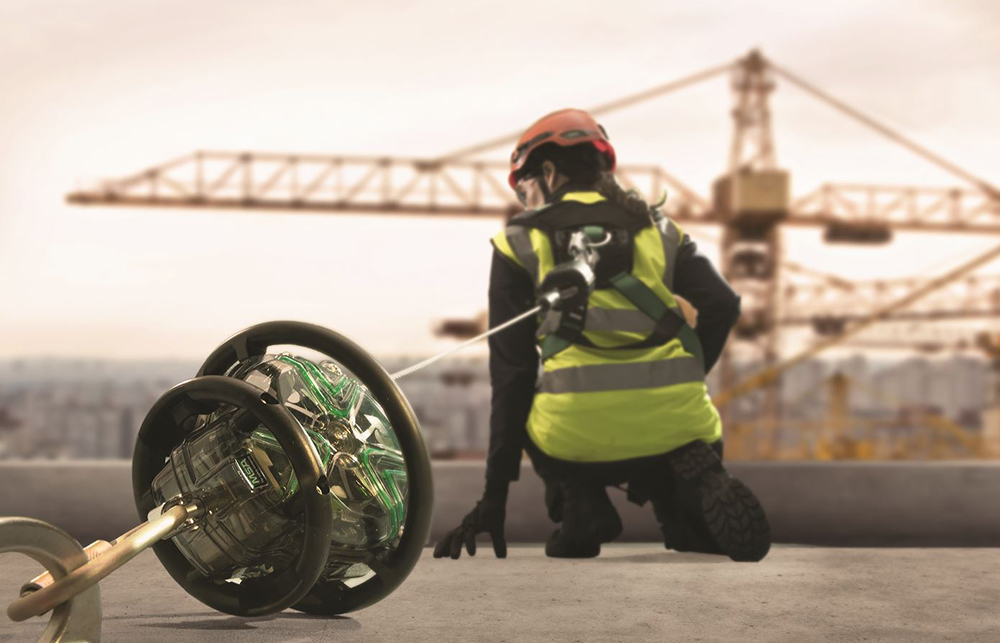
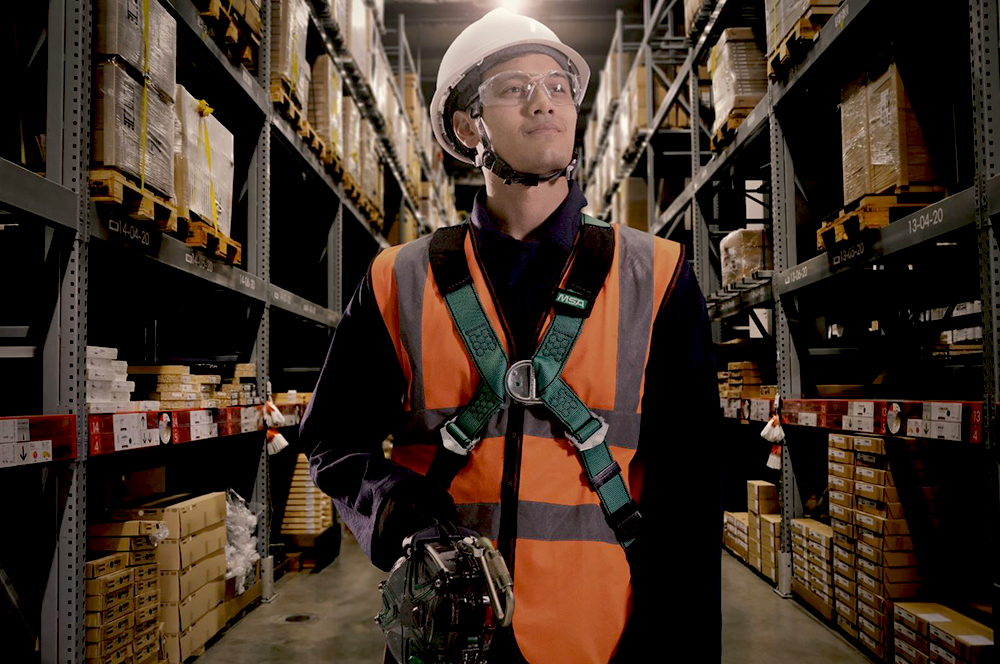
A synthetic line or metallic cable attached to the worker’s harness automatically extends and retracts from a floor or overhead anchored container unit as the worker moves. In the event of a fall, the product will ‘lock-on’ to arrest the force of the fall, and an energy absorption system will then limit the impact of that force on the body of the worker in the harness.
‘There are a vast number of situations where fall protection is necessary, and it’s important to consider the individual differences between applications.’
Jon Rowan, MSA Safety
SRL systems and the working environment
One of the first factors to consider when specifying the correct SRL system is the application and environment. What are the atmospheric conditions? In a coastal location, for instance, continuous exposure to saltwater vapour poses the risk of accelerated corrosion for metal parts.
Similar corrosive hazards can be present in petrochemical sites, posing potential degradation risks for SRL plastics and composites. SRL specification options available from MSA, for example, include the use of sealed SRL casings, military-grade plastics and high-grade S4 stainless steel components that provide additional barriers against corrosion.
Understanding SRL anchors
An SRL is there to provide a fall arrest point. It will always be attached to an anchor which may be in different locations:
Overhead anchor point: this is the standard way to attach an SRL – to a carabiner or point above the workspace. This approach is traditionally seen when there has been an investment in infrastructure, and the benefit is that in the case of a slip or trip, there is less distance to fall.
Foot level anchor point: a foot or deck level tie off – positioned at foot level, with the SRL attached. This is a more common approach and is in many ways easier to use as nothing needs to be lifted overhead. However, it does mean that if the worker falls, the product is at a 90-degree angle to the fall. On many sites edges of roofs and structures can be sharp, so a foot level anchor must always be tested and ‘edge rated’.
Understanding your anchor point is the first step in making an appropriate product choice - you need to consider where the anchor is, how far it is away from the working point and how far away it is from the edge. Being conscious of fall clearance is also vital – having knowledge of distance means you can allow enough space for a fall to happen in the safest way possible. Once these things are understood, you can make an informed choice on safety equipment, such as SRLs.
Match the solution to the application and value of product
There are a vast number of situations where fall protection is necessary, and it’s important to consider the individual differences between applications. For example, working with solar panels on a rooftop or servicing an aircraft wing will require care to prevent equipment causing damage. Using a synthetic web lifeline will minimise the risk of damaging products and surfaces.
SRLs are used in a range of applications and industries
Conversely the presence of sharp edges that could sever a fabric line necessitates use of a high-grade steel cable. Similarly, a construction site may have abrasive concrete dust that will degrade synthetic lines, requiring a steel cabled solution.
SRLs are also inherently versatile and used across a range of industries and horizontal, overhead and leading-edge applications. From vertical access via pylons, turbines, water towers and confined spaces in general, to loading and maintenance bays, assembly lines, silos, rooftops and the building and construction industry at large, SRLs can help to take the guesswork out of equipment selection.
Another factor to consider is fall clearance – the minimum vertical distance required between a worker’s feet and a lower level, which can also vary at different points on the working area. A self-retracting lifeline can accommodate significant variance since it remains under tension and automatically adjusts the line. As an example, the latest addition to MSA Safety’s V-Series SRL range offers a new maximum line extension of 30m.
How quality design enhances lifetime performance and reduces cost
Ultimately, the design of an SRL directly impacts safety and whole service-life cost. Employers have a duty of care to reduce risks faced by their workers. While technically all products are certified to the same standard, the reality is that not all are created equal. Entry-level, economy priced PPE is much less likely to offer the same performance and durability as higher quality, more premium solutions.
Trying to minimise expenditure at the outset can be a false economy. Investing in the best equipment can yield lifetime savings and result in lower total cost of ownership. For example, equipment that is inherently designed to be serviceable in the field and minimise repair times can dramatically reduce costly downtime and delays.
Smart retraction dampening technology which, in some instances can reduce cable retraction speed by up to 3m/s, can also not only increase safety but limit damage to the product and surroundings, thus minimising downtime and further maximising product lifespan.
The January/February 2026 issue of Construction Management magazine is now available to read in digital format.
Powered Access
CM, in partnership with IPAF, has launched a new survey to explore the industry’s views and experiences with powered access machines on construction projects.
This is not a first step towards a paywall. We need readers to register with us to help sustain creation of quality editorial content on Construction Management. Registering also means you can manage your own CPDs, comments, newsletter sign-ups and privacy settings. Thank you.