Construction Management is the highest circulation construction-based publication serving the UK built environment.
Opinion
Construction output forecasts look bright – but what about tender prices?
Pablo Cristi Worm Turner & Townsend
The past two decades offer a clear illustration of the dynamic between construction output and tender price inflation (Image: Dreamstime.com)
Although construction output data offers useful insights for tender prices, considering other indicators is crucial to get a fuller picture, says Pablo Cristi Worm.
Construction tender price inflation (TPI), the rate that measures the trend of contractors’ pricing levels in accepted tenders, can be a challenging metric to both measure and predict. It can fluctuate significantly and is heavily influenced by a series of macro and microeconomic factors. However, interrogating TPI’s key data points helps bring insight into the potential for future fluctuations.
Demand is one of the most decisive drivers of tender price inflation. As investment and activity increase, contractors become busier, leading to a shortage of builders and decreasing competition. With less competition, securing work becomes easier, allowing contractors to be more selective about which projects to bid on and ultimately resulting in higher prices. Conversely, if the market price of an asset is perceived as low, then fewer firms would want to supply the product.
This is not a paywall. Registration allows us to enhance your experience across Construction Management and ensure we deliver you quality editorial content.
Registering also means you can manage your own CPDs, comments, newsletter sign-ups and privacy settings.
This situation arises because firms are in competition with each other. For example, in the London commercial property market, when the return on investment in offices is low, property prices are high, and the returns reflect the low risk of property investment. In such a market, developers may see an opportunity to develop a site and sell into the high-price office market at what appears to be an attractive profit.
Output and tender price dynamic
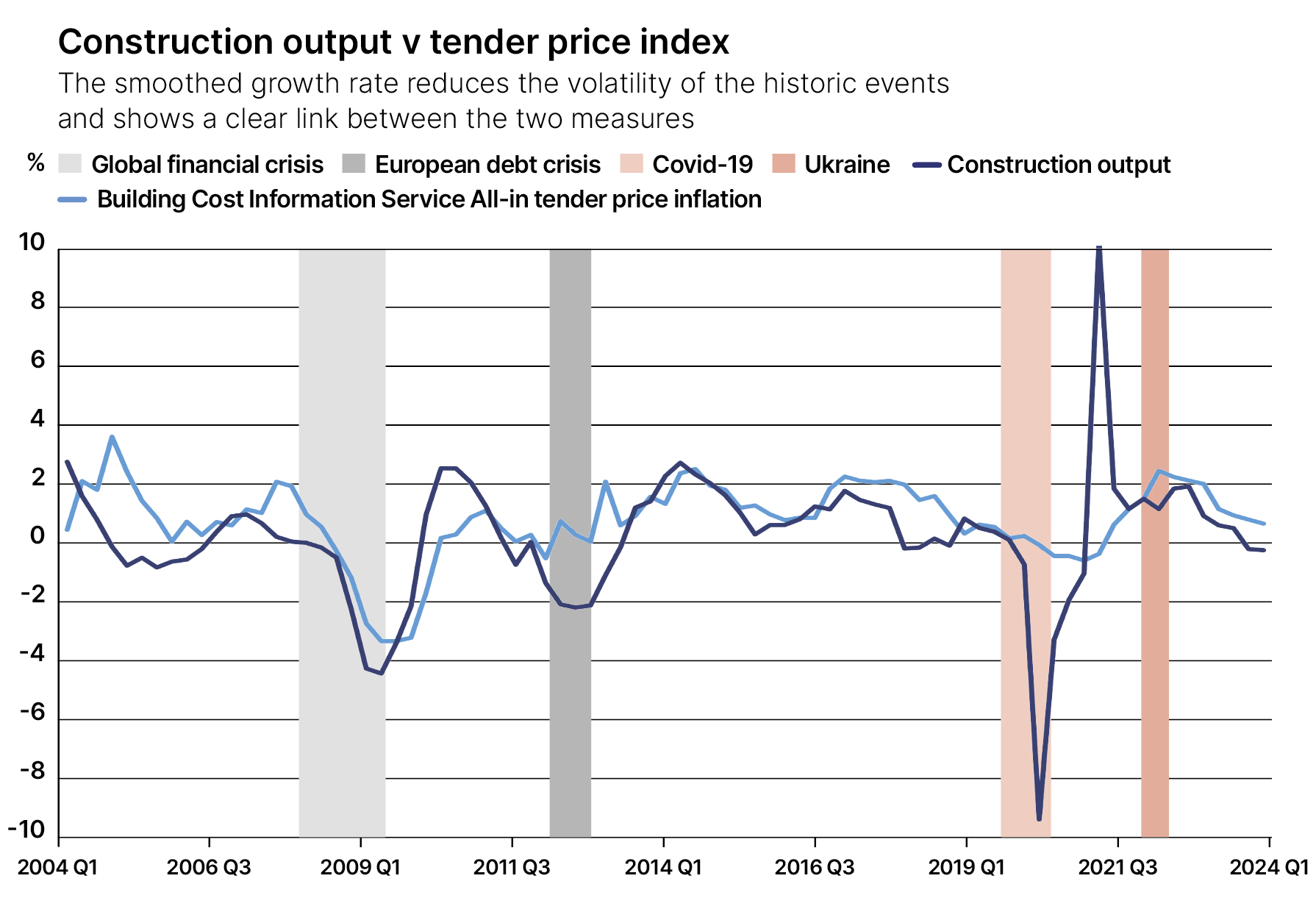
The past two decades offer a clear illustration of the dynamic between construction output and tender price inflation. Construction output has echoed economic performance, with sharp contractions during the global financial crisis in 2008 and the European sovereign debt crisis in 2012. Construction output plummeted again during the Covid-19 pandemic, and more recently has been impacted by the ongoing conflict in Ukraine and global supply chain disruption.
Source: Building Cost Information Service and Office for National Statistics
This decline in output has been mirrored in tender price inflation trends. The smoothed data in the top graphic on p13 reduces the volatility of the time series and shows a clear link between the two measures. In this case, the smoothed series is a moving average of the previous six months. This flattens out any sudden peaks and troughs and keeps only the volatility that is due to persistent shocks, like Covid-19 or the conflict in Ukraine. After the sharp drop and subsequent rebound following the pandemic, construction output peaked at 3.2% in Q1 2022 but has been trending downwards ever since.
By Q4 2023, construction output had contracted by 0.9%, repeating this contraction in Q1 2024. Similarly, the All-in TPI from the Building Cost Information Service (BCIS) peaked in Q2 2022 at 4.6% quarter-on-quarter, decreasing to 0.5% in both Q4 2023 and Q1 2024.
Future outlook for demand
Despite recent declining construction output, sentiment within the sector continues to paint an optimistic picture. Indicators like the June S&P Global UK Construction PMI are positive, and workload expectations as measured by the RICS construction market survey show a doubling in Q1 2024 compared to the previous quarter.
Construction new orders, a forward-looking snapshot of potential future activity in the construction industry, offer a positive outlook as well. Q1 2024 saw a significant quarterly increase of 15.9% in the total value of new orders – the best quarterly performance since Q4 2021, just before the conflict in Ukraine began.
Source: Barbour ABI
Since TPI closely tracks fluctuations in construction output, an increase in tender prices is also likely. However, construction projects involve lengthy periods between planning and actual work commencement. As such, new orders don’t automatically translate to immediate activity.
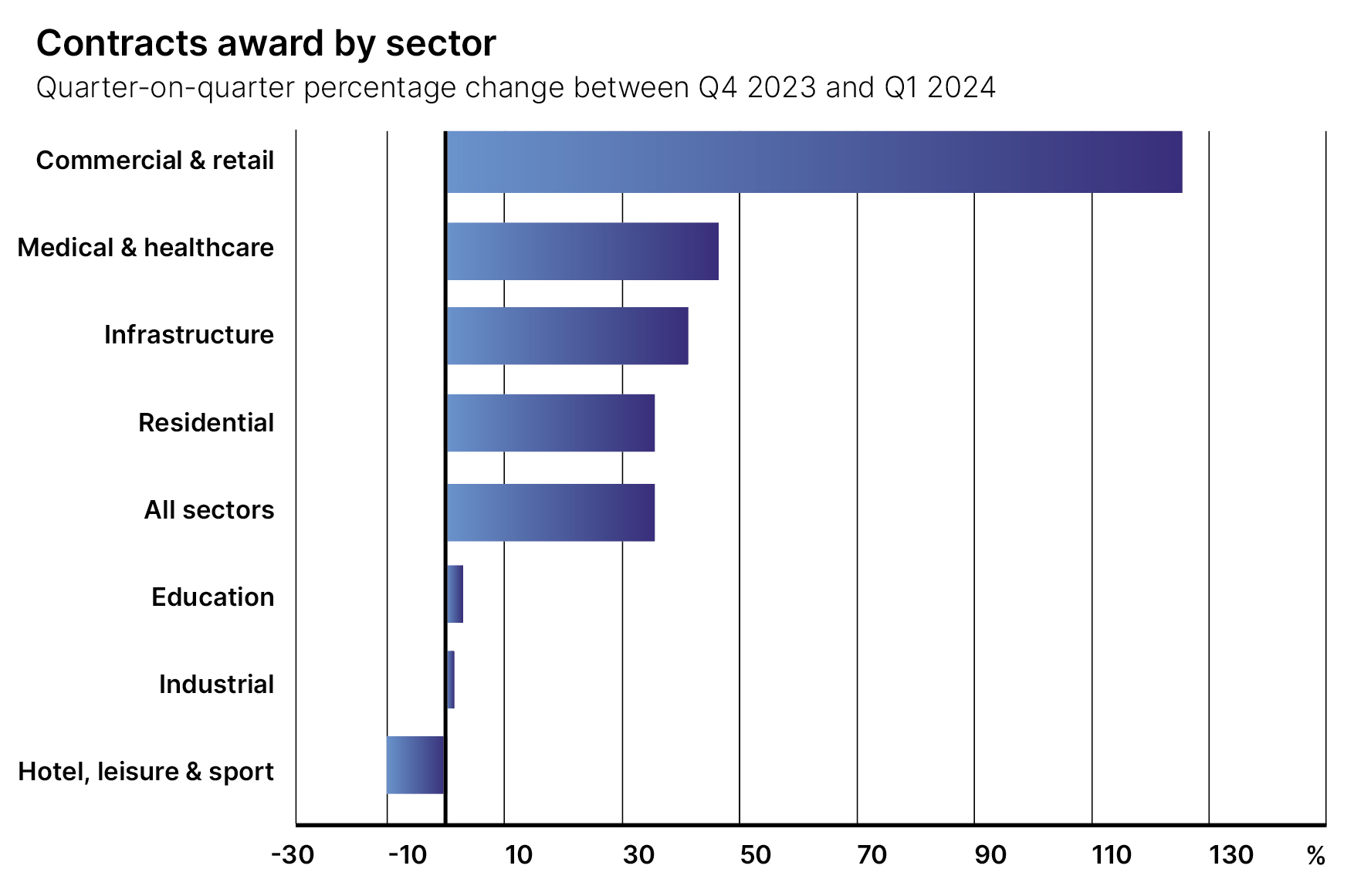
Barbour ABI’s contracts award data offers insight into projects that are closer to starting work on site. This also presents a bright picture, with awards for Q1 2024 showing a robust increase of 35% compared to Q4 2023. The commercial and retail sector is showing the most significant growth within construction, driven primarily by refurbishment projects. However, this is starting from a lower initial base, as the office fit-out sector, for example, is reawakening from a period of dormancy.
The January/February 2026 issue of Construction Management magazine is now available to read in digital format.
Powered Access
CM, in partnership with IPAF, has launched a new survey to explore the industry’s views and experiences with powered access machines on construction projects.
This is not a first step towards a paywall. We need readers to register with us to help sustain creation of quality editorial content on Construction Management. Registering also means you can manage your own CPDs, comments, newsletter sign-ups and privacy settings. Thank you.