














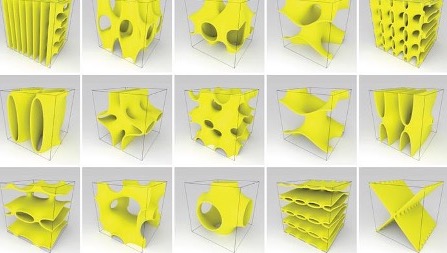
Scientists have developed a specialised computer aided design (CAD) system for metamaterials allowing engineers to model and experiment with design.
Metamaterials are built from nanoparticles, often composite plastics and metals, and comprise extremely small, repetitive patterns. They have multiple potential uses including in electronics, insulation, heat transfer and in photovoltaics as well as acoustics and noise reduction.
Researchers from Massachusetts Institute of Technology (MIT) and the Institute of Science and Technology Austria said their technique makes it quicker and easier to model artificial metamaterials, edit their structures and simulate their properties.
They said the application can speed up progress for engineers by days at a time, as well as allow for the inclusion of a mix of metamaterial shapes, which until now was not possible.
By choosing just one type of metamaterial structure at the start you “limit your exploration and introduce a bias based on your intuition” said MIT electrical engineering and computer science graduate student Liane Makatura, co-lead author of the paper.
The technique also allows users to quickly construct high performing triply periodic minimal surface (TPMS), highly complex metamaterial structures that are laborious to develop.
Makatura added: “Our representation makes all sorts of structures more accessible to people. We were especially pleased with users’ ability to generate TPMS.
“These complex structures are usually difficult even for experts to generate. Still, one TPMS in our study had the lowest average modelling time out of all six structures, which was surprising and exciting.”
Long term, researchers plan to develop the system for inverse design. This would mean specifying a desired material property and then using an algorithm to find the optimal metamaterial structure.
Don’t miss out on BIM and digital construction news: sign up to receive the BIMplus newsletter.


