Construction Management is the highest circulation construction-based publication serving the UK built environment.
Technical
Ashe Construction’s passive fire protection strategy: early engagement is key
Rob Hatchett Ashe Construction
Ashe Construction quality manager Rob Hatchett MCIOB explains the importance of planning passive fire protection at the outset of a project.
(Image: Maxim Tajer, Unsplash)
Ashe Construction is a member of GIRI, the Get It Right Initiative, which aims to eliminate error and improve quality in the construction industry. One key area we are focusing on, to eliminate errors and avoid rework, is passive fire protection.
We work in collaboration with Quelfire, Ashe’s preferred manufacturer of passive fire protection systems, to ensure it is considered early in the design process.
This is not a paywall. Registration allows us to enhance your experience across Construction Management and ensure we deliver you quality editorial content.
Registering also means you can manage your own CPDs, comments, newsletter sign-ups and privacy settings.
Buildings are designed to be divided into smaller spaces, or ‘compartments’, which form a protective barrier in the event of a fire to help contain flames and smoke. Preventing the spread reduces the risk of injury or loss of life and provides building protection. But when building services such as ducting, electrical and data cabling and water pipes need to penetrate walls, floors or ceilings, they compromise the compartmentation.
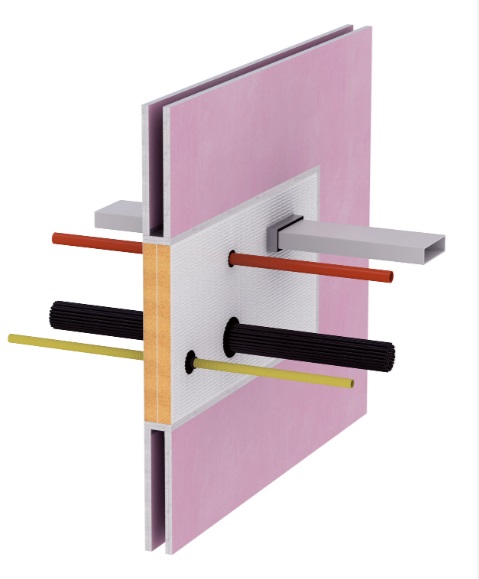
Passive fire protection systems create a seal around these services as they penetrate a wall, which is tested and certified as preventing smoke or fire escaping for a recommended period, allowing occupants to escape and the emergency services to be called.
Early engagement
Our early engagement starts with providing our fire consultants with detailed information about the fire rating and insulation integrity required. For example whether it needs to withstand 30 or 60 minutes, or more, exposure to fire. We also tell them the construction methods being used and the type of substrate that any fire protection seals will be fitted to.
A multi-service penetration seal in a fire compartment wall (image: Quelfire).
There are strict rules about the distance between each service penetration and the depth and thickness of any seals to ensure robust compartmentation of the building. We also use appropriate frames or service holders to ensure they are secured into place.
The fire consultant needs to know whether it’s a multi-service penetration, a single penetration, or whether there will be a letterbox opening with a framed and lined aperture. Knowing these key details is vitally important to ensure there is no way of fire or smoke penetrating a wall, floor or ceiling through unsealed gaps around services.
Using a specialist design tool – Quelselector, supplied by Quelfire – designers, site and project managers can easily identify a tested passive fire-stopping detail when they need one and a robust, project-specific design can be created.
Early engagement allows potential fire hazards and risks to be identified and addressed upfront, ensuring that the design prioritises the safety of the building occupants and the first responders.
Regulatory compliance
We can also ensure regulatory compliance by collaborating with our fire safety experts and passive fire-stopping specialists early and be confident that our design meets all relevant building codes, regulations, and standards related to fire protection, such as Approved Document B.
This proactive approach minimises the risk of compliance issues arising during the construction phase and avoids costly delays and rework.
We also ensure we are minimising the costs by addressing passive fire-stopping requirements early in the design phase by identifying cost-effective solutions that deliver optimal fire protection without exceeding budget. This proactive cost management approach helps minimise unexpected expenses associated with retrofitting or remediation work later in the project lifecycle.
It is thought that 21% of costs are due to error and 37% of accidents on site are as a result of rework, so reducing errors through early involvement and getting it right first time is a priority for Ashe.
The January/February 2026 issue of Construction Management magazine is now available to read in digital format.
Powered Access
CM, in partnership with IPAF, has launched a new survey to explore the industry’s views and experiences with powered access machines on construction projects.
This is not a first step towards a paywall. We need readers to register with us to help sustain creation of quality editorial content on Construction Management. Registering also means you can manage your own CPDs, comments, newsletter sign-ups and privacy settings. Thank you.